ECS POCKET GUIDE
Table of Contents
FOUNDATIONS
THE CHRONIC SYMPTOM SECTIONS
- Chronic Pain Discussion
- Acute Pain Discussion
CLINICAL APPLICATION
QUICK REFERENCE
APPENDIX

THE ENDOCANNABINOID SYSTEM
(ECS) Pocket Reference
FOR CLINICIANS
Full-Spectrum Hemp Therapeutics for the Most Common Symptoms
A MECHANISM-FIRST REFERENCE:
symptoms → diagnosis → the endocannabinoid system → phytocannabinoid & terpene therapy
Michael D. Steward, MD1; Leonard Wisneski, MD, FACP2; Byron Jones, MD3; Jamie Wood, PhD4; and Chris Lundwall, MBA5

Or explore the guide in it's entirety below
How to Use This Reference
Clinicians are trained in a dependable arc: identify and measure symptoms, diagnose a cause, reason from the mechanisms of action (MoAs) of molecules to a treatment that resolves the symptom. No widely accepted text applies that same arc to medical hemp. This reference is built to fill that gap — a deliberately brief, template-driven quick reference that respects how clinicians already think, then adds one layer they were never taught: the endocannabinoid system (ECS) as the master regulatory system these molecules act upon.
Use the Table of Contents to quickly navigate to a specific section of interest to you.
The following four-part template will be used in each section, so the format disappears and the content stands out:
-
PART-1 · Symptoms & Presentation — how the condition presents, and what is known or believed to cause it, in mechanistic terms.
-
PART-2 · Conventional Diagnosis & Treatment — how the condition is diagnosed today and how standard drugs work, by MoA.
-
PART-3 · The ECS Pathway to Homeostasis — how a healthy, well-resourced ECS naturally resolves these symptoms.
-
PART-4 · Full-Spectrum ECS Therapy — which cannabinoids and which terpenes fit the target, with MoAs wherever they exist.
Each section opens with an ECS Mechanism Map and a Dual-MoA View — a table that renders mechanism in two related contexts side by side: the MoAs that drive the chronic symptom, and the endocannabinoid MoAs the ECS uses to remediate it, paired row by row with the actives that engage each one. Each section closes with a three-bullet Key Take-Aways box and its own numbered reference list.
The Evidence Key
Confidence in medical hemp comes from evidentiary honesty, not overstatement. Every citation in this reference carries a tag naming the strength of the underlying evidence, so the reader always knows what a claim rests on:
-
{{RCT}} — randomized controlled trial in humans.
-
{{OBS}} — other human study (observational, open-label, or case series).
-
{{PRE}} — preclinical: in vitro or animal model. Mechanistically informative; not yet proof of human efficacy.
-
{{REV}} — review, guideline, or meta-analysis.
-
{{FND}} — foundational reference text or landmark paper.
A candid caveat: much of the cannabinoid and, especially, terpene literature is still preclinical. That is stated plainly throughout rather than papered over. Where human trial evidence exists — notably for anxiety, insomnia, and Long COVID — it is flagged as such; where it is thin, that too is named.
FOUNDATIONS
Introduction - The Endocannabinoid System: Components & Mechanisms of Action
This introduction sets out its parts and how each works — the mechanisms of action a clinician reasons from. The system has three functional classes: the signals (endocannabinoids), the receptors they act on, and the enzymes that build and clear them. Together they form a self-limiting, on-demand loop that adjusts activity precisely where and when balance is threatened.

SIGNALS - THE ENDOCANNABINOIDS
The two principal endocannabinoids are anandamide (AEA) and 2-arachidonoylglycerol (2-AG). Unlike classical neurotransmitters they are not stored in vesicles; they are synthesized on demand from membrane phospholipids when a cell's activity raises intracellular Ca²⁺ — 2-AG by diacylglycerol lipase (DAGLα) and AEA largely by NAPE-PLD. Once made, they act as retrograde messengers, released from the postsynaptic cell to travel backward across the synapse and quiet the presynaptic terminal. 2-AG is a full agonist at CB1 and CB2 and the most abundant endocannabinoid; AEA is a partial agonist that also engages TRPV1. This make-on-demand, act-locally, then-clear design is what lets the ECS make small, targeted corrections rather than broad, sustained ones.1
RECEPTORS - WHERE THE SIGNALS ACT
CB1 is the most abundant G-protein-coupled receptor in the central nervous system — dense in cortex, basal ganglia, hippocampus, cerebellum, and the pain axis (dorsal-root ganglia, dorsal horn, periaqueductal gray) — with peripheral expression as well. It couples to Gᵢ/ₒ: activation inhibits adenylyl cyclase (↓ cAMP), suppresses voltage-gated Ca²⁺ channels, and opens K⁺ channels, the net effect being reduced neurotransmitter release — the presynaptic 'brake' underlying much of the ECS's analgesic, anxiolytic, and calming action. CB1 also mediates THC's psychoactivity through partial agonism; CBD, by contrast, is a negative allosteric modulator of CB1 that tempers this activation. This produces the non-intoxicating, low-amplitude engagement the clinician desires.2
CB2, also Gᵢ/ₒ-coupled, sits chiefly on immune and glial cells (microglia, macrophages, lymphocytes) and, more sparsely, in the CNS. Its activation dampens pro-inflammatory cytokine release and immune-cell activation without psychoactivity — the system's principal anti-inflammatory lever, and the target of β-caryophyllene.2
Endocannabinoids and phytocannabinoids reach beyond CB1/CB2. TRPV1, an ionotropic vanilloid channel, is activated by anandamide and by CBD; sustained activation desensitizes it, reducing nociceptor firing — this is an important analgesic mechanism.4 PPARα and PPARγ are nuclear receptors whose engagement suppresses NF-κB-driven inflammation and supports metabolic and mitochondrial function. 5-HT1A, a serotonin receptor activated by CBD has anxiolytic and antidepressant effects, and GPR55 (a putative 'CB3') contributes further signaling.3,5 This is how a full-spectrum, polypharmacologic preparation reaches targets.
ENZYMES - MAKING & CLEARING THE SIGNALS
The ECS is fast and self-limiting because dedicated enzymes both build and break its signals. This is important as therapeutics can target these enzymes to manipulate the ECS. Synthesis is handled by DAGLα (2-AG) and NAPE-PLD (AEA); degradation is the key regulatory step, with fatty-acid amide hydrolase (FAAH) hydrolyzing anandamide and monoacylglycerol lipase (MAGL) hydrolyzing 2-AG. Because these enzymes rapidly terminate signaling, endocannabinoid tone stays tight and local — and inhibiting FAAH raises anandamide, the mechanism CBD partially exploits to prolong the body's own calming signal rather than flooding receptors with an external agonist.1,3
ECS COMPONENTS & PRINCIPAL MOAS - REFERENCE TABLE
ECS Components & Principal MoAs — Reference Table
A consolidated view of every component, its class and location, its principal mechanism of action, and the hemp actives that engage it.


Together these components explain the therapeutic logic of the sections that follow: full-spectrum hemp supplies ligands that engage these receptors at low amplitude and modulate enzymes that set tone — supporting the ECS's own homeostatic work rather than overriding it.
REFERENCES
1. Lu HC, Mackie K. An introduction to the endogenous cannabinoid system. Biol Psychiatry. 2016;79(7):516–525. [FOUNDATIONAL]
2. Zou S, Kumar U. Cannabinoid receptors and the endocannabinoid system: signaling and function in the central nervous system. Int J Mol Sci. 2018;19(3):833. [REVIEW]
3. Di Marzo V. New approaches and challenges to targeting the endocannabinoid system. Nat Rev Drug Discov. 2018;17(9):623–639. [REVIEW]
4. Muller C, Morales P, Reggio PH. Cannabinoid ligands targeting TRP channels. Front Mol Neurosci. 2019;11:487. [REVIEW]
5. Pertwee RG. The diverse CB1 and CB2 receptor pharmacology of three plant cannabinoids: Δ9-tetrahydrocannabinol, cannabidiol and Δ9-tetrahydrocannabivarin. Br J Pharmacol. 2008;153(2):199–215. [REVIEW]
FOUNDATIONS
The Endocannabinoid System: The Body's Master Regulator
Having met the components in the Introduction, consider what they accomplish together. The endocannabinoid system is the largest neuromodulatory network in the body and the master regulator of homeostasis — the moment-to-moment maintenance of internal balance across the nervous, immune, endocrine, and digestive systems.1 The background level of its activity — its endocannabinoid tone — is what keeps every other system near in homeostasis.
The ECS is a retrograde signaling system. When a system drifts — pain signaling climbs, an immune response overshoots, sleep architecture frays — endocannabinoids are released precisely on-demand where needed, engage their receptors, restore balance, and are then enzymatically cleared. Analgesia, resolution of inflammation, and a calm return to sleep are accomplished in this frame as ordinary acts of homeostasis performed by a healthy ECS.
The Depletion Hypothesis — and Clinical Endocannabinoid Deficiency (CECD or CED)
While the ECS is a self-regulating system, it is not designed to run 24/7 without adequate nutrition and detoxification. The Standard American Diet (SAD) is not a friend to the ECS.

This reference rests on a specific, simple, testable and repeatable premise: chronic disease begins when exterior stressors outpace the ECS's capacity to keep systems balanced. While not all chronic disease is specifically caused by a depleted ECS, all chronic disease stresses and depletes the ECS. Persistent infection (including SARS-CoV-2 spike-protein exposure), toxins, injury, poor sleep, sustained inflammation, and chronic psychological stress can deplete endocannabinoid tone. When tone falls below a functional threshold, the master regulator can no longer do its work. Homeostatic failure expresses itself as familiar chronic symptom clusters — pain, anxiety, depression, insomnia, fatigue, and the multi-system picture of Long COVID are all symptomatic of a clinical ECS deficiency.
Ethan Russo formalized part of this idea as Clinical Endocannabinoid Deficiency (CECD or CED): the proposition that deficient endocannabinoid signaling underlies many of the treatment-resistant syndromes such as migraine, fibromyalgia, and irritable bowel. These symptoms share features and frequently co-occur.2 Whether framed as CECD or more broadly as depletion, the clinical implication is the same and it reframes the therapeutic goal: not to suppress a symptom, but to restore the tone of the system that resolves symptoms. Full-spectrum phytocannabinoids and terpenes are, on this view, a way to supplement a depleted regulator.
The Entourage Effect — a Discussion of Terpene Pharmacology
Hemp's therapeutic value is a property of the whole preparation, not of any single molecule. A full-spectrum extract carries the plant's full complement of cannabinoids together with its terpenes and flavonoids, and these constituents act synergistically — the entourage effect first described by Russo.3 Terpenes are not merely aroma. Recent receptor pharmacology shows common cannabis terpenes act as partial agonists at CB1 and CB2: a 2021 study found several terpenes are cannabimimetic and selectively enhance cannabinoid activity,4 and a 2025 electrophysiology study demonstrated dose-dependent terpene activation of both receptors — with lower or equivalent potency to THC and, at CB2, multiple terpenes reaching a clinical-effect level at concentrations at or below THC's.5 Terpenes also engage non-cannabinoid targets (GABA-A, TRPV1, adenosine, serotonergic pathways), broadening the therapeutic reach of the formulation.6 Dose-dependent activation of these receptors translates into the ability to have very low amounts of THC and sustain efficacy with a compliment of targeted terpenes. This allows therapeutic formulations to use very low, or trace, amounts of THC and thereby attenuate the THC bias that some clinicians and patients still hold.
Breadth is the point. A depleted regulatory system is rarely restored by a single lever or molecule. In summary: full-spectrum hemp is polypharmacologic and low-amplitude. It engages the same CB1/CB2 receptors as high-THC cannabis, but gently and across many targets at once. This reduces the risk of drug-drug interactions as well as other side effects, including intoxification and euphoria.
REFERENCES
1. Lu HC, Mackie K. An introduction to the endogenous cannabinoid system. Biol Psychiatry. 2016;79(7):516–525. [FOUNDATIONAL]
2. Russo EB. Clinical endocannabinoid deficiency reconsidered: current research supports the theory in migraine, fibromyalgia, irritable bowel, and other treatment-resistant syndromes. Cannabis Cannabinoid Res. 2016;1(1):154–165. [REVIEW]
3. Russo EB. Taming THC: potential cannabis synergy and phytocannabinoid-terpenoid entourage effects. Br J Pharmacol. 2011;163(7):1344–1364. [REVIEW]
4. LaVigne JE, Hecksel R, Keresztes A, Streicher JM. Cannabis sativa terpenes are cannabimimetic and selectively enhance cannabinoid activity. Sci Rep. 2021;11:8232. [PRECLINICAL]
5. Raz N, Eyal AM, Fahoum-Khalefa N, Tauber M, Ben-Chaim Y. Selective activation of cannabinoid receptors by cannabis terpenes. Biochem Pharmacol. 2025 (Epub Oct 30). [PRECLINICAL]
6. Ferber SG, Namdar D, Hen-Shoval D, et al. The 'entourage effect': terpenes coupled with cannabinoids for the treatment of mood disorders and anxiety disorders. Curr Neuropharmacol. 2020;18(2):87–96. [REVIEW]
FOUNDATIONS
The Clinician's Label Test for Medical Hemp Formulations
To make safe and effective recommendations, clinicians need to know the content of any formulation. A full-spectrum hemp preparation contains on the order of ~400 active constituents: the plant's full complement of cannabinoids (~200), its medicinal and aromatic terpenes (~200), and the lesser-studied flavonoids. CBD is only one component of that formulation — a necessary part, but not the product. Describing such a preparation as a 'CBD product' dramatically understates what it is. An analogy is describing a finished automobile by one of its subsystems, such as a brake or an axle. Without all constituents working together, they are not as effective as they could be. We define a therapeutic as the complete, indication-targeted formulation, not any single molecule within it. Because these constituents work together, they must be known together — which is accomplished with the Label Test.

What is Required
To be effective, evidence-based medicine depends on knowing what is being administered. A hemp-derived therapeutic — or any future FDA-approved botanical medicine of this class — passes the Label Test when its label itemizes every active constituent, including terpenes, with quantities; it fails when it omits terpenes or their amounts, hides actives behind a 'proprietary blend,' or reduces the plant to a single isolate. Concretely, a clinician should require:
-
Complete itemization with amounts. Every cannabinoid and every active terpene listed individually, in milligrams — not a lone 'total cannabinoids' figure. Terpenes are active pharmacology in their own right (see the receptor evidence in the Introduction) and belong on the label with amounts.
-
Full spectrum, never an isolate. Medical hemp is here defined operationally as the full complement of compounds harvested from the hemp flower — never an organic or synthetic single-molecule isolate. The entourage among cannabinoids, terpenes, and flavonoids is the therapeutic, not any one molecule.
-
Verified potency and purity. A batch-specific Certificate of Analysis (third-party tested) confirming the label, with Δ9-THC stated and below 0.3%.
-
Enough to dose and to screen interactions from the label alone. The amounts must let a clinician titrate deliberately and check drug interactions at the point of care — for example, CBD's inhibition of CYP2C9 is relevant to warfarin dosing, a check the label should make possible.
A product that hides its actives, however safe and effective it may be, limits the clinician’s ability to fully understand and utilize it. The Label Test is the minimum a clinician should demand before making an informed, confident recommendation.
REFERENCES
1. Russo EB. Taming THC: potential cannabis synergy and phytocannabinoid-terpenoid entourage effects. Br J Pharmacol. 2011;163(7):1344–1364. [REVIEW]
2. Brown JD, Winterstein AG. Potential adverse drug events and drug-drug interactions with medical and consumer cannabidiol (CBD) use. J Clin Med. 2019;8(7):989. [REVIEW]
3. Hudson R. The big book of terps: understanding terpenes, flavonoids, and synergy in cannabis. Hudson Press; 2021.
FOUNDATIONS
Methodology, Evidence Standards & Scope
The Biological Foundation
This reference rests on a stated hypothesis-chain, made explicit so the reader can weigh it: (a) the ECS regulates homeostasis throughout the body; (b) chronic disease frequently arises when exterior stressors deplete the ECS and inhibit that regulation; and (c) phytocannabinoids and terpenes from hemp — a low-THC (<0.3%) Cannabis sativa — can support a declining or compromised ECS. Each section applies this chain of reasoning adding the ECS as the connective layer.
Evidence Standards
Claims are tagged by evidence strength (see the Evidence Key). Preclinical mechanism is presented as mechanism, not as proof of human efficacy; human trial data is identified as such. Nothing here asserts that hemp cures disease.
Scope, Regulatory Status & Access Model
This reference is published by Front Range Pharmaceuticals (FRP), which researches, develops, produces and publishes studies of endocannabinoid-system-targeted therapeutics, including FDA submissions — making FRP uniquely qualified to provide clinicians with educational ECS content. These therapeutics are marketed to clinicians by Endourage over-the-counter (OTC) for clinical use until they are FDA approved. The hemp actives referenced here are federally legal nationwide at <0.3% THC. Although safe for everyone, content is intended for adults, and patients are best served obtaining product with recommendations through their clinician, keeping care and product together.
Cannabis & Hemp Research Before 2018: Reading the Old Evidence Critically
FOUNDATIONS
Clinicians reasonably ask why, if medical hemp is useful, the older literature is thin or unflattering. The answer is that most pre-2018 cannabis research was shaped by constraints that have little to do with the hemp therapeutics described in this reference — and understanding those constraints is essential to weighing today's rapidly improving evidence.
The Pre-2018 Information About Cannabis is Limited & Biased – Supporting Evidence
-
A single-source supply monopoly. For decades the only cannabis U.S. researchers could legally study came from one federally contracted farm at the University of Mississippi, supplying the National Institute on Drug Abuse's Drug Supply Program since 1968.1 Independent analysis found this federally produced cannabis was genetically and chemically divergent from products in legal markets — narrow genetics, frequently low or uncharacterized potency — so findings often did not generalize to what patients actually use.2 In fact, this cannabis was referred to as “the hay from Mississippi.”
-
Schedule I prohibition. Cannabis's Schedule I classification — 'no accepted medical use, high potential for abuse' — made study approvals slow and onerous.3
-
Combustion as the delivery method. Much early work administered cannabis by smoking a cigarette — a non-standardized, unmeasurable route that varies breath to breath and adds respiratory harm — making dose and exposure impossible to pin down.1,4
-
High-THC marijuana, not hemp. Studies overwhelmingly examined high-THC marijuana, frequently at high and inconsistent doses, while low-THC hemp and full-spectrum, terpene-inclusive formulations went essentially unstudied.2,4
-
Weak characterization of participants. Comorbidities, concomitant medications, and other participant attributes were often poorly measured, confounding outcomes and limiting what could be concluded (although this seldom stopped authors from making these conclusions).
-
No commercial incentive. A multi-molecule botanical FDA path did not exist prior to 2016. U.S. patent law rewards single, novel molecules; a multi-molecule botanical is difficult to patent. Investors and industry had little financial reason to fund full-spectrum research.
What Changed After 2018 — A Legitimate Path Forward
The 2018 Farm Bill (Agriculture Improvement Act of 2018) removed hemp — Cannabis sativa with <0.3% Δ9-THC — from the Controlled Substances Act, making it federally legal and open to ordinary research.5 Just as important, the FDA's Botanical Drug Development pathway (established 2016) provides a legitimate route for a multi-constituent botanical to earn FDA approval under the same rigorous standards applied to single-molecule drugs — the pathway Front Range Pharmaceuticals pursues.6 Public and private research is now generating higher-quality, dose- and route-controlled data on efficacy and safety for pain, sleep, anxiety, depression, and fatigue — including randomized, placebo-controlled trials of full-spectrum formulations, such as the Long COVID study described in Section 6.. Additionally, the FDA continues to update its botanical pathway, making it more appealing to those using medicinal hemp.
The Objective Takeaway for Clinicians
Older negative or alarming findings largely reflect high-dose, high-THC, combusted marijuana studied under biased, non-generalizable conditions — not low-THC, full-spectrum, precisely dosed medical hemp. Historically the conclusions drawn from comparing high-THC, un-controlled, combusted marijuana to medical hemp have hampered appropriate and responsible research. As the modern evidence base matures, it is increasingly obvious that full-spectrum medical hemp is safe and well-tolerated. Medical hemp gives clinicians an effective option without a significant adverse-effect burden.
REFERENCES
1. Stith SS, Vigil JM. Federal barriers to Cannabis research. Science. 2016;352(6290):1182. [REVIEW]
2. Vergara D, Bidwell LC, Gaudino R, et al. Compromised external validity: federally produced cannabis does not reflect legal markets. Sci Rep. 2017;7:46528. [HUMAN STUDY]
3. Nutt DJ, King LA, Nichols DE. Effects of Schedule I drug laws on neuroscience research and treatment innovation. Nat Rev Neurosci. 2013;14(8):577–585. [REVIEW]
4. National Academies of Sciences, Engineering, and Medicine. The health effects of cannabis and cannabinoids: the current state of evidence and recommendations for research. Washington, DC: National Academies Press; 2017. [REVIEW]
5. Agriculture Improvement Act of 2018, Pub L No. 115-334, 132 Stat 4490 (2018). [FOUNDATIONAL]
6. US Food and Drug Administration. Botanical drug development: guidance for industry. Silver Spring, MD: FDA; December 2016. [FOUNDATIONAL]
CHRONIC SYMPTOMS - SECTION ONE
Pain
Acute and chronic pain — the most common reason patients seek care.
Chronic Pain

Symptoms & Presentation
Chronic pain is defined as pain that persists beyond normal tissue-healing time (conventionally >3 months) and takes three overlapping forms: nociceptive pain from actual or threatened tissue damage (aching, throbbing, well-localized); neuropathic pain from nerve injury or dysfunction (burning, shooting, electric, with allodynia and hyperalgesia); and nociplastic/systemic pain from altered central processing without clear tissue or nerve damage (widespread, as in fibromyalgia).1 The common thread is that the nervous system becomes hyper- sensitized to pain, the signaling is amplified and sustained rather than resolved.
Nociceptive pain itself divides into two subtypes worth distinguishing at the point of care. Somatic pain originates in muscles, bone, skin, tendons, and connective tissue; it is usually well-localized and, when superficial or musculoskeletal, is usually reachable by a full-spectrum topical applied at the site. Visceral pain originates in the internal organs — including the heart, liver, and gastrointestinal tract — and is often diffuse, referred, and, in everyday practice, easy to overlook. Because a topical cannot reach the viscera, visceral pain is where a full-spectrum sublingual formulation is most useful, delivering systemic cannabinoid and terpene support to organs a surface cream cannot.
Mechanistically, peripheral injury and inflammation lower nociceptor thresholds, partly through TRPV1 channel sensitization. Sustained input drives central sensitization: spinal and supraspinal neurons grow hyperexcitable while descending inhibitory control weakens. Activated microglia and astrocytes release pro-inflammatory mediators that perpetuate the cycle — a neuroinflammatory loop that keeps pain 'on' long after the original insult.1 The inhibitory pain pathway becomes inhibited – and medicinal hemp can reactivate the inhibitory pain pathway.
Conventional Diagnosis & Treatment
Diagnosis is clinical — history, pain mapping, validated instruments (numeric rating scale, PROMIS Pain Interference), and examination to separate nociceptive from neuropathic components, with diagnostic injections, lab testing, imaging or nerve conduction studies as indicated.
First-line pharmacotherapy targets individual nodes of the pain circuit: NSAIDs and acetaminophen (peripheral prostaglandin synthesis); gabapentinoids (voltage-gated calcium channels) and SNRIs/TCAs (descending monoaminergic inhibition) for neuropathic pain; and opioids (μ-receptor agonism) for severe pain, constrained by tolerance, dependence, and overdose risk.2 Each addresses one node; none restores the system-level regulatory tone that normally keeps nociception in check.
Care is commonly multimodal and multidisciplinary: pharmacotherapy (non-opioid and opioid analgesics, antidepressants, and anticonvulsants) is combined, as indicated, with supervised therapies (ie physical therapy, occupational therapy and massage), and structured exercise; interventional and minimally invasive procedures such as epidural steroid injections, peripheral nerve blocks, radiofrequency ablation, spinal cord stimulation; and behavioral approaches such as cognitive-behavioral therapy. Recent syntheses of interdisciplinary multimodal pain treatment report improvements in health-related quality of life across chronic-pain populations.3
The ECS Pathway to Homeostasis
The ECS is a primary brake on pain signaling. CB1 receptors are dense in dorsal-root ganglia, the spinal dorsal horn, and the periaqueductal gray, where endocannabinoid release dampens transmission and reinforces descending inhibition. CB2 receptors on microglia and immune cells restrain neuroinflammation. Anandamide additionally desensitizes TRPV1.4 In a well-resourced ECS, injury triggers on-demand endocannabinoid synthesis that turns pain signaling down and resolves inflammation — analgesia as an act of homeostasis. When endocannabinoid tone is depleted, this brake fails and pain becomes chronic.5
Full-Spectrum ECS Therapy
Full-spectrum ECS hemp therapeutics supplies actives that engage every node above at low amplitude. β-Caryophyllene, a sesquiterpene and selective CB2 agonist, reduces inflammatory and neuropathic pain and spinal neuroinflammation in controlled animal models — effects abolished in CB2-knockout animals — and a 2025 study confirmed CB2-mediated relief of diabetic neuropathic pain.6,7 CBD blunts pain through TRPV1 desensitization, adenosine signaling, and anti-inflammatory action, while CBG and CBDA add complementary anti-inflammatory activity. Among terpenes, myrcene and linalool contribute analgesic and muscle-relaxant effects, and α-pinene and humulene add anti-inflammatory support; recent receptor work shows these terpenes act as low-efficacy partial agonists at CB1 and CB2, several reaching clinically relevant activation at the non-intoxicating CB2 receptor.8 Because every active is itemized with amounts on the label, clinicians can dose deliberately and screen for drug-drug interactions before recommending — the Label Test in practice.
KEY TAKE-AWAYS:
SYMPTOMS — Persistent (>3 mo) nociceptive, neuropathic, and/or nociplastic pain marked by peripheral and central sensitization.
DIAGNOSIS (MoAs) — TRPV1 sensitization, loss of descending inhibition, and microglial/astrocytic neuroinflammation sustain the pain loop.
ECS THERAPY — β-caryophyllene (CB2); CBD/CBG/CBDA (TRPV1, anti-inflammatory); with myrcene, linalool, and α-pinene as terpene support.
REFERENCES
1. Cohen SP, Vase L, Hooten WM. Chronic pain: an update on burden, best practices, and new advances. Lancet. 2021;397(10289):2082–2097. [REVIEW]
2. Dowell D, Ragan KR, Jones CM, et al. CDC clinical practice guideline for prescribing opioids for pain — United States, 2022. MMWR Recomm Rep. 2022;71(3):1–95. [REVIEW]
3. Turvill A, Maratos F, Sheffield D. Assessing the impact of interdisciplinary multimodal pain treatment on health-related quality of life in chronic pain: a systematic review and meta-analyses. Eur J Pain. 2026;30(1):e70176. [REVIEW]
4. Woodhams SG, Chapman V, Finn DP, et al. The cannabinoid system and pain. Neuropharmacology. 2017;124:105–120. [REVIEW]
5. Russo EB. Clinical endocannabinoid deficiency reconsidered. Cannabis Cannabinoid Res. 2016;1(1):154–165. [REVIEW]
6. Klauke AL, Racz I, Pradier B, et al. The cannabinoid CB2 receptor-selective phytocannabinoid beta-caryophyllene exerts analgesic effects in mouse models of inflammatory and neuropathic pain. Eur Neuropsychopharmacol. 2014;24(4):608–620. [PRECLINICAL]
7. Bagher AM. Intraplantar β-caryophyllene alleviates pain and inflammation in STZ-induced diabetic peripheral neuropathy via CB2 receptor activation. Int J Mol Sci. 2025;26(9):4430. [PRECLINICAL]
8. Raz N, Eyal AM, Fahoum-Khalefa N, Tauber M, Ben-Chaim Y. Selective activation of cannabinoid receptors by cannabis terpenes. Biochem Pharmacol. 2025 (Epub Oct 30). [PRECLINICAL]
Acute Pain
Recent-onset, localized pain from tissue injury — where topical full-spectrum hemp fits

Symptoms & Presentation
Acute pain is recent-onset, protective pain from an identifiable tissue injury — a burn, puncture, sprain, fracture, or surgical incision — that typically resolves within normal healing time (conventionally <3 months). Unlike chronic or systemic pain, it is predominantly nociceptive and inflammatory and is localized to the injury: local damage activates nociceptors directly (including TRPV1) and releases inflammatory mediators (prostaglandins, bradykinin, cytokines) that lower thresholds at the site (peripheral sensitization). Treated inadequately, sustained input can drive wind-up and central sensitization — the transition to chronic pain.1
Conventional Diagnosis & Treatment
Diagnosis is clinical — mechanism and onset, site, and severity (numeric rating scale, functional assessment tools) — with imaging or laboratory testing as indicated to characterize the injury. Management is commonly multimodal: physical measures such as rest, ice, and elevation; topical and oral NSAIDs and acetaminophen (peripheral prostaglandin synthesis); local anesthetics; short-course opioids reserved for severe injury; and supervised therapies (ie, physical, occupational, massage) or procedural care as indicated.
The ECS Pathway to Homeostasis
The skin and peripheral sensory nerve terminals carry a dense endocannabinoid system — CB1, CB2, and TRPV1 on keratinocytes, nerve endings, and local immune cells. At an injury, on-demand endocannabinoid release desensitizes TRPV1, engages peripheral CB1 to reduce nociceptor firing, and activates CB2 to quiet the local inflammatory response — analgesia delivered where the injury is, with little systemic involvement.2
Full-Spectrum ECS Therapy
Because acute pain is localized and peripheral, the primary modality is a topical full-spectrum hemp cream applied at the site rather than a sublingual systemic dose. Delivered locally, CBD and CBDA desensitize TRPV1 and blunt inflammation, β-caryophyllene engages CB2, and the breadth and depth of medicinal terpenes (myrcene, linalool, α-pinene, limonene) add local anti-inflammatory and analgesic activity while aiding dermal penetration. Transdermal CBD reduces inflammation and pain-related behaviors in controlled models,3 and a randomized topical-CBD study relieved peripheral neuropathic pain in the lower extremities;4 recent receptor work shows these terpenes act as partial CB1/CB2 agonists.5 Topical delivery gives measured application with minimal systemic exposure — and treating acute pain early and well may limit its transition to chronic pain.1
KEY TAKE-AWAYS:
SYMPTOMS — Recent-onset, localized, protective pain from identifiable tissue injury (burn, puncture, sprain, fracture, incision); predominantly nociceptive/inflammatory.
DIAGNOSIS (MoAs) — Direct nociceptor/TRPV1 activation and local inflammatory sensitization; undertreated acute pain can transition to chronic.
ECS THERAPY — Topical full-spectrum hemp (terpene breadth): CBD/CBDA (TRPV1), β-caryophyllene (CB2), myrcene/linalool/α-pinene — applied locally, minimal systemic exposure.
REFERENCES
1. Glare P, Aubrey KR, Myles PS. Transition from acute to chronic pain after surgery. Lancet. 2019;393(10180):1537–1546. [REVIEW]
2. Bíró T, Tóth BI, Haskó G, Paus R, Pacher P. The endocannabinoid system of the skin in health and disease: novel perspectives and therapeutic opportunities. Trends Pharmacol Sci. 2009;30(8):411–420. [REVIEW]
3. Hammell DC, Zhang LP, Ma F, et al. Transdermal cannabidiol reduces inflammation and pain-related behaviours in a rat model of arthritis. Eur J Pain. 2016;20(6):936–948. [PRECLINICAL]
4. Xu DH, Cullen BD, Tang M, Fang Y. The effectiveness of topical cannabidiol oil in symptomatic relief of peripheral neuropathy of the lower extremities. Curr Pharm Biotechnol. 2020;21(5):390–402. [HUMAN RCT]
5. Raz N, Eyal AM, Fahoum-Khalefa N, Tauber M, Ben-Chaim Y. Selective activation of cannabinoid receptors by cannabis terpenes. Biochem Pharmacol. 2025 (Epub Oct 30). [PRECLINICAL]
CHRONIC SYMPTOMS - SECTION TWO
Anxiety
Excessive, persistent worry and physiologic arousal that impair daily function.

Symptoms & Presentation
Generalized anxiety, panic, and social anxiety share persistent apprehension plus autonomic arousal — tachycardia, muscle tension, restlessness, impaired concentration, and disrupted sleep. Symptoms are disproportionate to circumstance and self-sustaining.
Mechanistically, anxiety reflects a hyperactive amygdala with insufficient prefrontal regulation, a hyperactive HPA axis (elevated cortisol), and dysregulated serotonergic and GABAergic signaling. Low anandamide tone is increasingly linked to heightened fear and stress reactivity, implicating the ECS directly in the disorder's biology.1
Conventional Diagnosis & Treatment
Diagnosis is clinical (DSM-5 criteria; GAD-7 and PROMIS Anxiety for measurement). Although the scientific research connecting low serotonin with anxiety and depression is not concluded, first-line treatment is SSRIs/SNRIs (raising synaptic serotonin/norepinephrine) plus cognitive-behavioral therapy; buspirone acts as a 5-HT1A partial agonist. Benzodiazepines (GABA-A potentiation) give rapid relief but carry tolerance, dependence, and sedation risk.2
The ECS Pathway to Homeostasis
The ECS tunes the stress response. Anandamide acting at CB1 in the amygdala and prefrontal cortex constrains fear signaling, facilitates extinction of aversive memories, and restrains HPA-axis output. A healthy ECS lets the body mount a stress response and then shut it off; a depleted ECS may not function as designed, leaving arousal 'stuck on.'1
Full-Spectrum ECS Therapy
CBD is the best-studied hemp isolate and is useful for anxiety4, with a mechanism profile complementary to CB1 signaling: it is a 5-HT1A agonist, inhibits FAAH (raising anandamide), and modulates TRPV1.1,3 Among terpenes, linalool potentiates GABA-A transmission and produces calming, anxiolytic effects; limonene modulates serotonin and dopamine with mood-lifting activity; and β-caryophyllene adds anxiolytic effect via CB2 in preclinical models.5,6 Recent receptor studies show these terpenes act directly as partial CB1/CB2 agonists — a mechanistic basis for the calm full-spectrum preparations produce beyond CBD alone.7 Label transparency lets clinicians titrate and check interactions before recommending.
KEY TAKE-AWAYS:
SYMPTOMS — Persistent worry with autonomic arousal, tension, and sleep disruption across GAD, panic, and social anxiety.
DIAGNOSIS (MoAs) — Amygdala hyperactivity, HPA-axis overdrive, serotonergic/GABAergic dysregulation, and low anandamide tone.
ECS THERAPY — CBD (5-HT1A, FAAH inhibition); with linalool (GABA-A), limonene (5-HT/DA), and β-caryophyllene (CB2).
REFERENCES
1. Blessing EM, Steenkamp MM, Manzanares J, Marmar CR. Cannabidiol as a potential treatment for anxiety disorders. Neurotherapeutics. 2015;12(4):825–836. [REVIEW]
2. Craske MG, Stein MB. Anxiety. Lancet. 2016;388(10063):3048–3059. [REVIEW]
3. Campos AC, Guimarães FS. Involvement of 5HT1A receptors in the anxiolytic-like effects of cannabidiol injected into the dorsolateral periaqueductal gray of rats. Psychopharmacology. 2008;199(2):223–230. [PRECLINICAL]
4. Gundugurti PR, Banda N, Yadlapalli SSR, et al. Efficacy, safety, and pharmacokinetics of nanodispersible cannabidiol oral solution versus placebo in mild-to-moderate anxiety: a double-blind multicenter randomized clinical trial. Asian J Psychiatr. 2024;97:104073. [HUMAN RCT]
5. Harada H, Kashiwadani H, Kanmura Y, Kuwaki T. Linalool odor-induced anxiolytic effects in mice. Front Behav Neurosci. 2018;12:241. [PRECLINICAL]
6. Ferber SG, Namdar D, Hen-Shoval D, et al. The 'entourage effect': terpenes coupled with cannabinoids for the treatment of mood disorders and anxiety disorders. Curr Neuropharmacol. 2020;18(2):87–96. [REVIEW]
7. Raz N, Eyal AM, Fahoum-Khalefa N, Tauber M, Ben-Chaim Y. Selective activation of cannabinoid receptors by cannabis terpenes. Biochem Pharmacol. 2025 (Epub Oct 30). [PRECLINICAL]
CHRONIC SYMPTOMS - SECTION THREE
Depression
Persistent low mood and anhedonia with cognitive and somatic features.
Symptoms & Presentation
Major depression presents with at least two weeks of depressed mood and/or anhedonia plus neurovegetative change — disturbed sleep and appetite, fatigue, psychomotor change, impaired concentration, guilt, and, in severe cases, suicidal ideation.
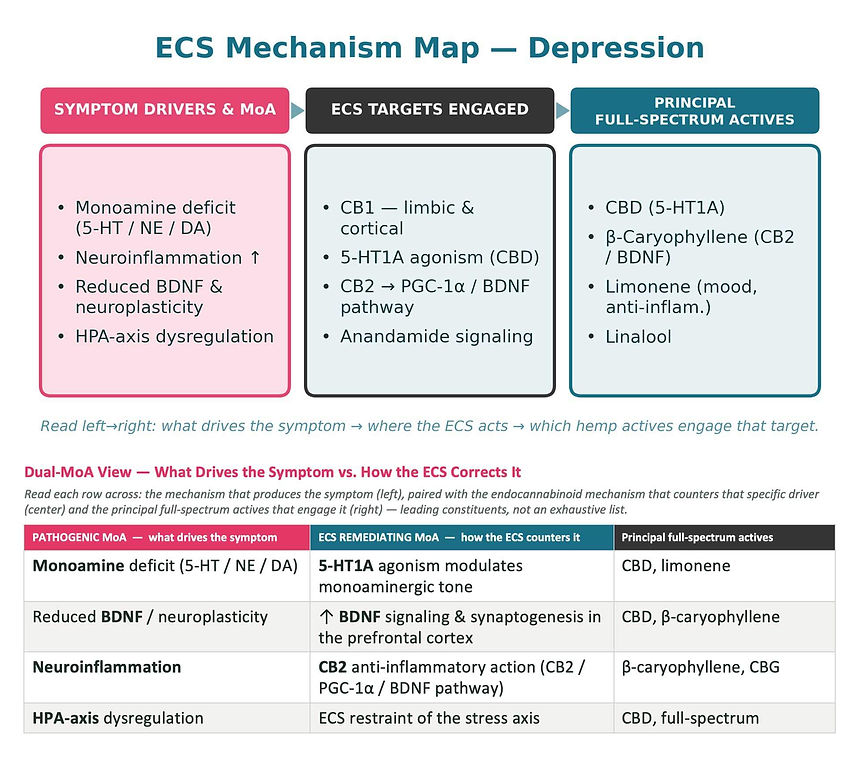
Fortunately, contemporary models have moved beyond the simplistic and unsubstantiated 'serotonin deficit model' and now emphasize pathways such as neuroinflammation, reduced BDNF-dependent neuroplasticity, HPA-axis dysregulation, and impaired monoaminergic (5-HT/NE/DA) signaling acting together — a systems failure rather than a single missing transmitter.1
Conventional Diagnosis & Treatment
Diagnosis is clinical (DSM-5; PHQ-9 and PROMIS Depression for measurement). First-line treatment has been SSRIs/SNRIs plus psychotherapy, with pharmaceutical augmentation (bupropion, mirtazapine, atypical antipsychotics) and — for treatment-resistant cases — ketamine/esketamine acting on glutamatergic plasticity. Fortunately, instances of electro-shock therapy are rare and the field's shift toward plasticity and inflammation as targets is notable.2
The ECS Pathway to Homeostasis
The ECS is woven into mood regulation. CB1 signaling in limbic and cortical circuits modulates monoamine release and stress resilience, and endocannabinoid tone supports neurogenesis and BDNF expression. Chronic stress lowers endocannabinoid signaling; restoring it produces antidepressant-like effects in preclinical models — positioning ECS support as an upstream lever on mood rather than a single-transmitter fix.3
Full-Spectrum ECS Therapy
CBD shows rapid antidepressant-like effects in animal models, mediated by 5-HT1A activation and increased BDNF signaling and synaptogenesis in the prefrontal cortex.3,4 β-Caryophyllene produces antidepressant- and anxiolytic-like effects through CB2, engaging a CB2/PGC-1α/BDNF pathway tied to mood and cognition.5 Limonene carries documented mood-elevating, stress-reducing activity, and classic clinical work found citrus aroma reduced the dose of antidepressant medication required in depressed patients.6 Full-spectrum preparations combine these serotonergic, neurotrophic, and anti-inflammatory mechanisms at low amplitude — a complement to established therapy while human evidence in this indication continues to mature.7
KEY TAKE-AWAYS:
SYMPTOMS — ≥2 weeks of depressed mood/anhedonia with sleep, appetite, energy, and cognitive disturbance.
DIAGNOSIS (MoAs) — Neuroinflammation, reduced BDNF/neuroplasticity, HPA dysregulation, and monoaminergic deficits.
ECS THERAPY — CBD (5-HT1A, BDNF) and β-caryophyllene (CB2/BDNF); with limonene and linalool as terpene support.
REFERENCES
1. Malhi GS, Mann JJ. Depression. Lancet. 2018;392(10161):2299–2312. [REVIEW]
2. Cipriani A, Furukawa TA, Salanti G, et al. Comparative efficacy and acceptability of 21 antidepressant drugs for the acute treatment of adults with major depressive disorder: a systematic review and network meta-analysis. Lancet. 2018;391(10128):1357–1366. [REVIEW]
3. de Mello Schier AR, de Oliveira Ribeiro NP, Coutinho DS, et al. Antidepressant-like and anxiolytic-like effects of cannabidiol: a chemical compound of Cannabis sativa. CNS Neurol Disord Drug Targets. 2014;13(6):953–960. [REVIEW]
4. Sales AJ, Fogaça MV, Sartim AG, et al. Cannabidiol induces rapid and sustained antidepressant-like effects through increased BDNF signaling and synaptogenesis in the prefrontal cortex. Mol Neurobiol. 2019;56(2):1070–1081. [PRECLINICAL]
5. Bahi A, Al Mansouri S, Al Memari E, et al. β-Caryophyllene, a CB2 receptor agonist, produces multiple behavioral changes relevant to anxiety and depression in mice. Physiol Behav. 2014;135:119–124. [PRECLINICAL]
6. Komori T, Fujiwara R, Tanida M, et al. Effects of citrus fragrance on immune function and depressive states. Neuroimmunomodulation. 1995;2(3):174–180. [HUMAN STUDY]
7. Ferber SG, Namdar D, Hen-Shoval D, et al. The 'entourage effect': terpenes coupled with cannabinoids for the treatment of mood disorders and anxiety disorders. Curr Neuropharmacol. 2020;18(2):87–96. [REVIEW]
CHRONIC SYMPTOMS - SECTION FOUR
Sleep Disturbance / Insomnia
Difficulty initiating or maintaining sleep, with daytime consequences.

Symptoms & Presentation
Insomnia is difficulty falling asleep, staying asleep, or non-restorative sleep on ≥3 nights per week for ≥3 months, with daytime impairment (fatigue, mood, concentration).
It is frequently a disorder of hyperarousal — elevated cortisol and sympathetic tone, and a racing mind at sleep onset — and is commonly secondary to pain, anxiety, or circadian disruption. These drivers travel together, which is why single-target hypnotics so often disappoint.1
Conventional Diagnosis & Treatment
Diagnosis is clinical (sleep history and diary, Insomnia Severity Index, actigraphy; polysomnography when another sleep disorder is suspected). Cognitive-behavioral therapy for insomnia (CBT-I) is first-line. Pharmacologic options include benzodiazepine-receptor agonists ('Z-drugs' and benzodiazepines, GABA-A potentiation), dual orexin-receptor antagonists, sedating antidepressants, and melatonin-receptor agonists — several effective short-term but limited by tolerance, next-day sedation, or dependence.2 The evidence for these agents is largely short-term: a 2022 network meta-analysis found insufficient evidence to support prescribing benzodiazepines or zolpidem for the long-term management of insomnia, and the AASM guideline grades every drug recommendation as weak and low-certainty, positioning CBT-I as the foundation.2,3 The result is a real gap in the standard of care — chronic reliance on agents whose hypnotic effect erodes with tolerance and which carry a well-documented dependence and withdrawal liability — and it is precisely the gap an ECS-restoration approach speaks to: supporting the body's own endocannabinoid tone rather than repeatedly agonizing a receptor until it downregulates.
The ECS Pathway to Homeostasis
The ECS is woven into mood regulation. CB1 signaling in limbic and cortical circuits modulates monoamine release and stress resilience, and endocannabinoid tone supports neurogenesis and BDNF expression. Chronic stress lowers endocannabinoid signaling; restoring it produces antidepressant-like effects in preclinical models — positioning ECS support as an upstream lever on mood rather than a single-transmitter fix.3
Full-Spectrum ECS Therapy
The full-spectrum rationale is well illustrated here. A 2025 double-blind, placebo-controlled crossover RCT in 125 adults with insomnia tested CBD (300 mg) with a defined terpene blend (linalool, myrcene, limonene, α- and β-pinene, α-terpinene, α-terpineol, β-caryophyllene, phytol) and found improved sleep physiology — a formulation-level result, not a single molecule.4 Mechanistically, CBD is biphasic (mildly alerting at low doses, calming at higher doses) and reduces anxiety-driven sleep-onset delay via 5-HT1A/TRPV1; a 2024 pilot RCT of 150 mg nightly supports its use in moderate-to-severe insomnia.5 α-Pinene enhances non-REM sleep through GABA-A/benzodiazepine sites; myrcene and linalool are sedative and muscle-relaxant; and CBN is traditionally described as mildly sedating, though human evidence remains limited and is flagged here as such.6 CBD is generally well tolerated in trials.7 With every active and amount on the label, dose can be titrated and interactions checked before recommending. Supporting the ECS should be a part of sleep hygiene.
KEY TAKE-AWAYS:
SYMPTOMS — Difficulty initiating/maintaining sleep ≥3 nights per week with daytime impairment, often driven by hyperarousal.
DIAGNOSIS (MoAs) — Elevated cortisol/sympathetic tone, circadian misalignment, and comorbid pain or anxiety.
ECS THERAPY — CBD (biphasic; 5-HT1A/TRPV1) plus α-pinene (GABA-A), myrcene, and linalool; CBN with limited evidence.
REFERENCES
1. Riemann D, Krone LB, Wulff K, Nissen C. Sleep, insomnia, and depression. Neuropsychopharmacology. 2020;45(1):74–89. [REVIEW]
2. Sateia MJ, Buysse DJ, Krystal AD, et al. Clinical practice guideline for the pharmacologic treatment of chronic insomnia in adults: an AASM clinical practice guideline. J Clin Sleep Med. 2017;13(2):307–349. [REVIEW]
3. De Crescenzo F, D'Alò GL, Ostinelli EG, et al. Comparative effects of pharmacological interventions for the acute and long-term management of insomnia disorder in adults: a systematic review and network meta-analysis. Lancet. 2022;400(10347):170–184. [REVIEW]
4. Wang M, Faust M, Abbott S, Patel V, Chang E, Clark JI, Stella N, Muchowski PJ. Effects of a cannabidiol/terpene formulation on sleep in individuals with insomnia: a double-blind, placebo-controlled, randomized, crossover study. J Clin Sleep Med. 2025;21(1):69–80. [HUMAN RCT]
5. Narayan AJ, Downey LA, Rose S, Di Natale L, Hayley AC. Cannabidiol for moderate–severe insomnia: a randomized controlled pilot trial of 150 mg of nightly dosing. J Clin Sleep Med. 2024;20(5):753–763. [HUMAN RCT]
6. Yang H, Woo J, Pae AN, et al. α-Pinene, a major constituent of pine tree oils, enhances non-rapid eye movement sleep in mice through GABAA-benzodiazepine receptors. Mol Pharmacol. 2016;90(5):530–539. [PRECLINICAL]
7. Chesney E, Oliver D, Green A, et al. Adverse effects of cannabidiol: a systematic review and meta-analysis of randomized clinical trials. Neuropsychopharmacology. 2020;45(11):1799–1806. [REVIEW]
CHRONIC SYMPTOMS - SECTION FIVE
Fatigue / Myalgic Encephalomyelitis / Chronic Fatigue Syndrome
Profound, persistent fatigue with post-exertional malaise — among the hardest chronic presentations to treat.

Symptoms & Presentation
Myalgic Encephalomyelitis (ME/CFS) / Chronic Fatigue Syndrome is defined by at least six months of disabling fatigue unrelieved by rest, with post-exertional malaise (symptom worsening after minimal exertion), unrefreshing sleep, cognitive impairment ('brain fog'), and orthostatic intolerance.1
Proposed drivers include neuroinflammation and glial activation, mitochondrial dysfunction with oxidative stress, autonomic dysfunction, and immune dysregulation — frequently triggered by infection. Russo has proposed that treatment-resistant syndromes of this kind may reflect Clinical Endocannabinoid Deficiency.2
Conventional Diagnosis & Treatment
Diagnosis is clinical and one of exclusion (IOM/NAM 2015 criteria; PROMIS Fatigue for measurement), after ruling out anemia, thyroid disease, primary sleep disorders, and mood disorders. No disease-modifying drug is approved; management is supportive — pacing to avoid post-exertional crashes, sleep and orthostatic support, and treatment of comorbid pain and mood. This therapeutic vacuum is precisely why mechanism-guided options draw interest.1
The ECS Pathway to Homeostasis
A functioning ECS restrains neuroinflammation (CB2), supports mitochondrial and redox balance (PPARα/γ), and stabilizes autonomic and stress-axis tone (CB1). If a depleted ECS contributes to the syndrome, restoring endocannabinoid tone is a rational, upstream target — addressing the shared inflammatory and energetic substrate rather than any single symptom.2
Full-Spectrum ECS Therapy
Direct trial evidence in Myalgic Encephalomyelitis / Chronic Fatigue Syndrome is limited, and that is stated plainly: the rationale is mechanistic and drawn from overlapping conditions. CBD is anti-inflammatory and mitigates oxidative stress; CBG adds anti-inflammatory and neuroprotective activity; β-caryophyllene engages CB2 on glia and immune cells; and limonene and α-pinene contribute anti-inflammatory, alerting, and mood support.3,4 The strongest adjacent human signal comes from post-viral fatigue: in the Long COVID RCT of a full-spectrum formulation (see Section 6), fatigue improved alongside sleep, mood, and cognition — a post-infectious phenotype that overlaps substantially with this syndrome.5 Full-spectrum, label-transparent formulation lets clinicians trial these actives cautiously and monitor response with validated fatigue measures.
KEY TAKE-AWAYS:
SYMPTOMS — ≥6 months disabling fatigue with post-exertional malaise, unrefreshing sleep, brain fog, and orthostatic intolerance.
DIAGNOSIS (MoAs) — Elevated cortisol/sympathetic tone, circadian misalignment, and comorbid pain or anxiety.
ECS THERAPY — CBD (biphasic; 5-HT1A/TRPV1) plus α-pinene (GABA-A), myrcene, and linalool; CBN with limited evidence.
REFERENCES
1. Institute of Medicine (National Academy of Medicine). Beyond myalgic encephalomyelitis/chronic fatigue syndrome: redefining an illness. Washington, DC: National Academies Press; 2015. [REVIEW]
2. Russo EB. Clinical endocannabinoid deficiency reconsidered. Cannabis Cannabinoid Res. 2016;1(1):154–165. [REVIEW]
3. Booz GW. Cannabidiol as an emergent therapeutic strategy for lessening the impact of inflammation on oxidative stress. Free Radic Biol Med. 2011;51(5):1054–1061. [REVIEW]
4. Gertsch J, Leonti M, Raduner S, et al. Beta-caryophyllene is a dietary cannabinoid. Proc Natl Acad Sci U S A. 2008;105(26):9099–9104. [PRECLINICAL]
5. Young TP, Erickson JS, Hattan SL, Guzy S, Hershkowitz F, Steward MD. A single-blind, randomized, placebo-controlled study to evaluate the benefits and safety of Endourage Targeted Wellness Formula C sublingual +drops in people with post-acute coronavirus disease 2019 syndrome. Cannabis Cannabinoid Res. 2024;9(1):282–292. [HUMAN RCT]
CHRONIC SYMPTOMS - SECTION SIX
Long COVID (Post-Acute Sequelae of SARS-CoV-2)
A multi-system, post-infectious disorder.

Symptoms & Presentation
Long COVID is the persistence or emergence of symptoms beyond roughly 12 weeks after acute SARS-CoV-2 infection, not explained by another diagnosis. Its hallmark is multi-system, multi-symptom involvement: fatigue and post-exertional malaise, cognitive impairment, dyspnea, sleep disturbance, anxiety and depression, and autonomic dysfunction such as postural orthostatic tachycardia.1
Leading mechanisms include persistent inflammation driven in part by viral/spike-protein antigen, immune dysregulation with elevated cytokines, endothelial and microvascular injury, and neuroinflammation — a shared inflammatory substrate expressing itself across many organs. Long COVID is valuable to study precisely because it is one well-defined post-infectious disease whose receptor mechanisms illuminate processes shared across many chronic conditions.1
Conventional Diagnosis & Treatment
Currently, there is no FDA-approved treatment for Long COVID.¹ That is beginning to change. On September 30, 2026, the FDA cleared an Investigational New Drug (IND) application allowing a randomized, double-blind, placebo-controlled Phase 2 trial of FRP-003 — an investigational full-spectrum botanical drug candidate directed at the ECS, developed by Front Range Pharmaceuticals, the publisher of this reference — in approximately 220 adults with fatigue-predominant Long COVID. The primary endpoint is change in fatigue (PROMIS Fatigue Short Form 8a) at day 56, with sleep disturbance and anxiety as secondary endpoints; enrollment is expected to begin in 2027.⁷ In the meantime, care is multidisciplinary and symptom-directed — pacing, autonomic and cardiopulmonary rehabilitation, and management of pain, sleep, and mood — typically within specialized Long COVID clinics. The absence of a disease-modifying option is the practical opening for ECS-directed support.¹
The ECS Pathway to Homeostasis
The ECS is a master regulator of immune and inflammatory tone. CB2 activation on immune cells dampens cytokine release; CB1 modulates neuro-autonomic function; and PPARγ engagement suppresses NF-κB-driven inflammation. Where post-viral stress has depleted endocannabinoid tone, restoring it targets the common inflammatory driver rather than chasing each symptom individually.2
Full-Spectrum ECS Therapy
Published human evidence supports full-spectrum ECS therapy in Long COVID. The preparation studied was a single full-spectrum, terpene-rich hemp formulation combining CBD with the minor cannabinoids CBC, CBG, and CBDV, trace Δ9-THC (<0.3%), and medicinal terpenes led by β-caryophyllene, α-humulene, and α-bisabolol — administered as sublingual drops held under the tongue for systemic absorption. In a single-blind, randomized, placebo-controlled trial with an open-label cross-over arm in Post-Acute COVID-19 Syndrome, the formulation was added to usual care; participants improved on 9 symptom domains by day 28 and 8 by day 56 — including anxiety, sleep, depression, fatigue, respiratory and cognitive function, and overall quality of life (roughly two-fold by day 28 and three-fold by day 56) — with no significant adverse events.³ One finding is especially instructive: post-hoc analysis showed the placebo contained no CBD but an unexpectedly medicinal concentration of terpenes, and the placebo arm also improved — a signal consistent with terpene activity in its own right.³ A mechanistic review details how whole-plant phytocannabinoids may maintain endocannabinoid tone against coronavirus-driven disease,⁴ and a registered real-world symptom-tracking study extends the observation.⁵ Receptor work reinforces the rationale: terpenes act as partial CB2 agonists at physiologically relevant concentrations, supporting the anti-inflammatory, peripheral role central to this indication.⁶ For practice, the transferable lessons are the attributes of the studied preparation: (1) the full complement of cannabinoids rather than an isolate; (2) medicinal terpenes present at disclosed, therapeutic amounts; (3) a sublingual route that delivers a reproducible systemic dose; and (4) a label that itemizes every active with quantities — the Label Test — so a clinician can match a preparation to the published composition and screen for drug–drug interactions before recommending.
KEY TAKE-AWAYS:
SYMPTOMS — Multi-system symptoms >12 weeks post-infection — fatigue/PEM, cognitive impairment, dyspnea, dysautonomia, sleep disturbance, and mood symptoms including anxiety and depression.
DIAGNOSIS (MoAs) — Spike-associated persistent inflammation, cytokine elevation, endothelial injury, and neuroinflammation.
ECS THERAPY — A single full-spectrum formulation (CBD/CBC/CBG/CBDV/trace Δ9-THC + itemized terpenes led by β-caryophyllene) engaging CB2, CB1, and PPARγ — the only indication here with a published randomized, placebo-controlled trial of a full-spectrum preparation.
REFERENCES
1. Al-Aly Z, Davis H, McCorkell L, et al. Long COVID science, research and policy. Nat Med. 2024;30(8):2148–2164. [REVIEW]
2. Cabral GA, Ferreira GA, Jamerson MJ. Endocannabinoids and the immune system in health and disease. Handb Exp Pharmacol. 2015;231:185–211. [REVIEW]
3. Young TP, Erickson JS, Hattan SL, Guzy S, Hershkowitz F, Steward MD. A single-blind, randomized, placebo-controlled study to evaluate the benefits and safety of Endourage Targeted Wellness Formula C sublingual +drops in people with post-acute coronavirus disease 2019 syndrome. Cannabis Cannabinoid Res. 2024;9(1):282–292. [HUMAN RCT]
4. Steward M, Wisneski L. Full-spectrum phytocannabinoids: a whole-plant holistic approach for maintaining optimal endocannabinoid tone and potentially attenuating the effects of acute and post-acute coronavirus-induced disease. 2023. [REVIEW] [confirm full journal citation before publication]
5. Symptom tracking in Long COVID patients using Formula C™ sublingual drops. ClinicalTrials.gov identifier NCT06163690. [HUMAN STUDY]
6. Raz N, Eyal AM, Fahoum-Khalefa N, Tauber M, Ben-Chaim Y. Selective activation of cannabinoid receptors by cannabis terpenes. Biochem Pharmacol. 2025 (Epub Oct 30). [PRECLINICAL]
7. Front Range Pharmaceuticals. Front Range Pharmaceuticals announces FDA clearance to initiate Phase 2 trial of FRP-003 in Long COVID [press release]. Business Wire; October 6, 2026. https://www.businesswire.com/news/home/20261006387219/en/ [REGULATORY]
CHRONIC SYMPTOMS - SECTION SEVEN
Cancer Treatment Symptoms
The symptom burden of chemotherapy — resolved through the ECS.
Written for oncology and primary-care clinicians in value-based models — including ACO REACH and the Enhancing Oncology Model — who, under the CMS Substance Access Beneficiary Engagement Incentive (effective 1 April 2026), may conduct shared-decision-making discussions and furnish eligible hemp products (≤0.3% Δ9-THC, non-inhalable) to aligned Medicare beneficiaries for symptom control. It addresses the symptoms of cancer treatment — not the treatment of cancer.

Symptoms & Presentation
Cancer chemotherapy is one of the most stressful treatments for the human body. Chemotherapy, radiation, and targeted agents commonly cause chemotherapy-induced nausea and vomiting (CINV), chemotherapy-induced peripheral neuropathy (CIPN), treatment-related pain, treatment and cancer-related fatigue, anorexia and weight loss, and a high prevalence of anxiety, depression, and insomnia — a cluster in which each symptom tends to worsen the others.1
Mechanistically, CINV is driven by chemotherapy-triggered serotonin (5-HT₃) and substance P (NK₁) release acting on the brain in such areas as the postrema and nucleus tractus solitarius; CIPN by direct axonal and neurotoxicity with TRPV1 sensitization and neuroinflammation; and the fatigue, mood, and sleep disturbances by mitochondrial toxicity and the same inflammatory and neuroinflammatory pathways described elsewhere in this reference. Here, the focus is to resolve the symptoms of the cancer’s treatment, leaving the direct effect on cancer and chemotherapeutic agents for a future discussion.
Diagnosis & Treatment
Traditionally the diagnosis of cancer is left to western medicine. This approach will focus on symptom management and not resolution of the cancer. Guidelines for antiemetic prophylaxis combines 5-HT₃ antagonists, NK₁ antagonists, dexamethasone (high potency steroid), and olanzapine (antipsychotic; not approved by FDA for nausea and yet, it has become a standard of care); painful CIPNs are treated with SSRIs/SNRIs as well as anti-psychotics; pain with opioids and adjuvants; fatigue with exercise and behavioral measures as well as pharmacological intervention; and mood, sleep, and appetite with antidepressants, sedative hypnotics, and appetite stimulants. Notably, two synthetic versions of THC have been approved by the FDA — dronabinol and nabilone — for chemotherapy-induced nausea and vomiting refractory to conventional antiemetics, and dronabinol for anorexia, so the mechanisms of action by which cannabis may be helpful is already established in oncology supportive care.1 Even so, each synthetic agent adds its own side-effects and interaction burden, and do not have the benefits of the full spectrum of hemp actives for safety, efficacy and potency – additionally, neither dronabinol nor nabilone restores the shared regulatory tone across the cluster.
The ECS Pathway to Homeostasis
The endocannabinoid system (ECS) is a body-wide signaling network that regulates virtually every physiological process, and its influence is especially clear in the pathways that govern nausea, pain, and inflammation. Within the brainstem's emetic circuitry — the neural machinery that generates the nausea-and-vomiting reflex — the ECS acts primarily through the CB1 receptor. Activating CB1 dampens that reflex, and this is precisely the mechanism the synthetics, including dronabinol, rely on to control nausea. In hemp-derived compounds, a serotonin receptor, 5-HT1A, is also engaged, rather than just the cannabinoid receptors, creating a synergistic effect, not seen with the synthetics.
The ECS also modulates sensory (pain-sensing) nerves. There, the CB2 receptor — expressed on immune cells and on glia, the support cells of the nervous system — works together with the desensitization of TRPV1, a sensor involved in pain and heat signaling. In controlled experimental models, this combined action blunts the inflammatory and neuropathic signaling that underlies chemotherapy-induced peripheral neuropathy (CIPN), the nerve damage and pain that certain cancer drugs can cause.2
Immunotherapy & Cancer
Caution becomes specific and warranted when it comes to immunotherapies. In immunotherapies, efficacy is immune-dependent and the rationale is that the immune-checkpoint inhibitors will mobilize the host’s own immunity to act against the cancer and the dying tumor cells may contribute to efficacy.3 In those settings, a systemic anti-inflammatory or immunomodulatory agent deserves an explicit risk–benefit conversation.
In the context of immunotherapy and cancer, it is important to differentiate between two different types of inflammation:
First: Host-Side Symptom-Driven Inflammation. This is the result of neuroinflammatory and neuropathic signaling caused by nausea and vomiting, peripheral neuropathy, mucositis, fatigue, and disturbed sleep — this is the target of supportive care and does not act on the tumor.
Second: Anti-Tumor Immune Inflammation. This is the immune activation some treatments deliberately provoke. Standard cytotoxic chemotherapy kills tumor cells primarily through apoptosis, mitotic catastrophe, necrosis, or senescence, and in solid tumors necrosis is common rather than exceptional. The decisive point for supportive care here is not the morphology of the death but whether or not the supportive care could interfere with the chemotherapy. If the direct cytotoxic kill does not require hosts inflammation for it to occur, dampening a patient’s symptomatic inflammation will not reverse it. In most cases, the inflammation that accompanies necrotic tumor death is largely a consequence of the kill, not its cause.4
The clinical evidence sits almost entirely in the checkpoint-inhibitor setting, is largely retrospective, and genuinely conflicting. It has shifted since the early alarm, and the pattern that matters is summarized below.
Key studies of cannabinoids with checkpoint-inhibitor immunotherapy. Signal shading: red = harm, blue = reassuring,
tan = mixed.

Read together, three conclusions are defensible. The harm signals are real but derive from the weakest designs — small, single-center, retrospective series unable to separate cannabinoid use from sicker patients or heavier tobacco exposure. The larger and more systematic recent evidence is reassuring: a 684-patient pooled analysis found no harm (and a possible progression-free benefit), and a 2025 systematic review of 40 studies found no meaningful change in the immune parameters relevant to ICI function.7,8
Most instructive for this thesis is that the distribution of cannabinoids, terpenes and flavonoids in hemp formulations are important and that the documented harm signals all cluster around THC in high doses or as a synthetic.
Taha studied high-THC marijuana, not hemp — Israeli medical cannabis (herbal flower and oil) with THC categorized at ≥10%, roughly thirty times the <0.3% THC that defines medical hemp (though within that marijuana cohort the reduced response rate did not track THC percentage); in the Hadid cohort, where the patient overall-survival signal was strongest, 82% of the “cannabis” was actually dronabinol, a single-molecule synthetic THC with no minor cannabinoids and no terpenes and no flavonoids.5,6 This is consistent with the mechanism most implicated in immune suppression and cannabis: potent CB2 agonism, which THC drives strongly. It is therefore fair to say that the existing harm data are largely about isolated, synthetic, or dominant THC — not about low-relative-THC, and terpene-complete medical hemp. Two honest caveats keep this from becoming overstatement. First, no oncology study has yet compared full-spectrum, terpene-rich hemp head-to-head against high-THC cannabis for treatment outcomes, so the distinction is mechanistically grounded but not yet clinically proven. Second, β-caryophyllene — a major hemp terpene — is itself a selective CB2 agonist, so terpene-rich does not necessarily mean free of immune-relevant signaling; the credible advantage of a complete formulation is balance and low relative THC, not the absence of CB2 activity. Some reviewers accordingly favor low-CB2-agonism constituents (CBD, CBG) nearest to immunotherapy.9
Separate from the immune question, the concrete interaction risk present in every patient is pharmacokinetic: CBD inhibits CYP450 enzymes (CYP3A4, CYP2C19, CYP2C9) that metabolize many chemotherapeutic and supportive-care agents.10 This is precisely where the Label Test earns its place — a clinician can screen a drug–drug interaction only when every active and its amount is disclosed on the label. Because clinically relevant CYP interactions are chiefly a higher-dose phenomenon — an estimated ≥300 mg/day of CBD, with narrow-therapeutic-index drugs the exception — those disclosed milligrams also tell the clinician where a patient sits relative to that threshold (see The Clinician’s Label Test and the Drug–Drug Interactions section).a
Practical Guidance for the Treating Clinician
-
Drug-Drug Interactions & Synergies. Part of the clinician’s responsibility is to check for drug-drug interactions, to see if they are synergistic, and to see if they are positive or negative.
-
Identify if there is a potential problem with the existing regimen first. Immune checkpoint inhibitors and ICD-type chemotherapy (anthracyclines, oxaliplatin, cyclophosphamide, radiation) are the settings that warrant the most caution and an explicit, documented risk–benefit discussion before use.
-
Favor low-THC, full-spectrum formulations. Concern rises with the level of THC exposure. Single-molecule dronabinol and nabilone carry this high-THC exposure risk unmitigated by the entourage effect of other cannabinoids, terpenes and flavonoids. A complete hemp formulation inclusive of cannabinoids, terpenes and flavonoids is low in THC low and utilizes multiple synergies between cannabinoids, terpenes and flavonoids.
-
Evaluate drug-drug interactions and synergies from the label. Hemp formulations are polypharmacologic and low-amplitude. Recognize that drug-drug interactions are rare at low doses and consider if a drug-drug interaction is theoretical or clinical. The primary concern will be the CYP450 pathway in the liver. The Label Test can help clinicians evaluate whether or not hemp products may be used synergistically and whether or not a modification in dosing may be indicated.
-
Symptom-directed treatment with hemp products is no longer controversial. Supporting the ECS during chronic illness improves quality of life. A single-blind, randomized, placebo-controlled trial of a full-spectrum formulation in post-acute COVID-19 (Long COVID) improved anxiety, sleep, depression, fatigue, and quality of life with no significant adverse events (see Section 6).11
-
Collaboration -- Document shared decision-making. For example, the Centers for Medicare & Medicaid Services (CMS) not only endorses medication review and shared decision-making as good practice — it requires them under its Substance Access Beneficiary Engagement Incentive (BEI).
Full-Spectrum ECS Therapy
The evidence for supporting the ECS to resolve nausea is very strong, and the way that the ECS resolves neuropathy is well understood. For CINV, a randomised, placebo-controlled phase II crossover trial found that an oral THC:CBD extract added to standard antiemetics improved the complete-response rate in refractory CINV and was preferred by most participants.12 For CIPN, the rationale is mechanistic — a peripheral CB2 mechanism suppresses chemotherapy-induced neuropathy in animal models.2 A pilot trial of a CBD-isolate topical, by contrast, did not improve established neuropathy — reinforcing that the full-spectrum entourage, not a single molecule, is what the mechanism predicts.13
The best way to treat CIPN is to prevent it. For treatment-related pain, fatigue, anxiety, depression, and insomnia, the mechanisms and actives are those already detailed in Sections 1–5 — β-caryophyllene (CB2), CBD (5-HT1A/TRPV1/PPARγ), CBG and CBDA, and the terpenes myrcene, linalool, limonene, and α-pinene — deployed as part of one full-spectrum preparation rather than a drawer of single-symptom drugs. Because every active is itemized with amounts on the label, the oncology or primary-care clinician can dose deliberately and screen for interactions with chemotherapy and supportive medications at the point of care — precisely the medication-review and shared-decision-making conversation the CMS Substance Access BEI calls for.
KEY TAKE-AWAYS:
SYMPTOMS — Treatment-related CINV, CIPN, pain, cancer-related fatigue, anxiety/depression, insomnia, and appetite loss — a compounding cluster.
DIAGNOSIS (MoAs) — 5-HT₃/NK₁ emetic signaling, neurotoxic/TRPV1 neuropathy, and a shared inflammatory and neuroinflammatory substrate.
ECS THERAPY — CB1 (emesis, appetite), CB2/TRPV1 (neuropathy), and 5-HT1A/GABA-A/PPAR (mood, sleep, redox); see Sections 1–5.
REFERENCES
1. Kleckner AS, Kleckner IR, Kamen CS, et al. Opportunities for cannabis in supportive care in cancer. Ther Adv Med Oncol. 2019;11:1758835919866362. [REVIEW]
2. Lin X, Xu Z, Carey LM, Romero J, Makriyannis A, Hillard CJ, et al. A peripheral CB2 cannabinoid receptor mechanism suppresses chemotherapy-induced peripheral neuropathy: evidence from a CB2 reporter mouse. Pain. 2022;163(5):834–851. doi:10.1097/j.pain.0000000000002502. [PRECLINICAL]
3. Galluzzi L, et al. Trial watch: chemotherapy-induced immunogenic cell death in oncology. OncoImmunology. 2023;12(1):2219591. [REVIEW]
4. Green DR, Ferguson T, Zitvogel L, Kroemer G. Immunogenic and tolerogenic cell death. Nat Rev Immunol. 2009;9(5):353–363. [REVIEW]
5. Taha T, Meiri D, Talhamy S, Wollner M, Peer A, Bar-Sela G. Cannabis impacts tumor response rate to nivolumab in patients with advanced malignancies. The Oncologist. 2019;24(4):549–554. [HUMAN STUDY]
6. Hadid T, Biedny A, Mamdani H, et al. Association between cannabis use and clinical outcomes in patients with solid malignancies receiving immune checkpoint inhibitors. Ther Adv Vaccines Immunother. 2024;12:25151355241309095. [HUMAN STUDY]
7. Coschi CH, Ding K, Tong J, et al. Effects of cannabinoids on immune checkpoint inhibitor response: CCTG pooled analysis of individual patient data. Immunotherapy. 2025;17(4):257–268. [HUMAN STUDY]
8. Behling-Hess C, Simonson G, Salz T, Fleege N, Zylla D. The impact of cannabis on immune checkpoint inhibitor therapy: a systematic review of immunomodulatory effects of cannabis in patients with and without cancer. Support Care Cancer. 2025;33(3):166. [REVIEW]
9. Vigano ML, Wang L, As’sadiq A, et al. Impact of cannabinoids on cancer outcomes in patients receiving immune checkpoint inhibitor immunotherapy. Front Immunol. 2025;16:1497829. [REVIEW]
10. Papakyriakopoulou P, et al. Cannabinoids and drug–drug pharmacokinetic interactions: deciphering the risks. Br J Clin Pharmacol. 2026 (online ahead of print). [REVIEW]
11. Young TP, Erickson JS, Hattan SL, Guzy S, Hershkowitz F, Steward MD. A single-blind, randomized, placebo-controlled study to evaluate the benefits and safety of Endourage Targeted Wellness Formula C sublingual +drops in people with post-acute coronavirus disease 2019 syndrome. Cannabis Cannabinoid Res. 2024;9(1):282–292. [HUMAN RCT]
12. Grimison P, Mersiades A, Kirby A, et al. Oral THC:CBD cannabis extract for refractory chemotherapy-induced nausea and vomiting: a randomised, placebo-controlled, phase II crossover trial. Ann Oncol. 2020;31(11):1553–1560. [HUMAN RCT]
13. D’Andre S, Novotny P, Walters C, et al. Topical cannabidiol for established chemotherapy-induced neuropathy: a pilot randomized placebo-controlled trial. Cannabis Cannabinoid Res. 2024;9(6):e1556–e1564. [HUMAN RCT]
CLINICAL APPLICATION
Modality — Routes of Administration
How a medical hemp formulation is delivered determines its onset, duration, bioavailability and — the deciding clinical requirement — how precisely it can be dosed. For evidence-based practice a route should deliver a measurable, reproducible dose; if a dose cannot be measured, it is difficult to titrate or check drug-interactions.1

Although there are other routes of administration which may be situationally appropriate, there are two routes that meet the clinical requirement for accurate, reproducible dosing: sublingual (for systemic effect) and topical (for localized effect). Oral products deliver an exactly known dose into the mouth, but how much reaches the bloodstream is inconsistent because phytocannabinoids are largely destroyed by first-pass hepatic metabolism — so oral is measurable in intent but not in effect and is discouraged where a dependable systemic dose matters.1,2 Inhalation and vaporization act quickly but are difficult to quantify breath to breath and add respiratory considerations, making them poorly suited to precise therapeutic dosing. When paired with the Label Test, a consistent and measurable route of administration allows clinicians to titrate and check drug interactions with confidence.
REFERENCES
1. Millar SA, Stone NL, Yates AS, O'Sullivan SE. A systematic review on the pharmacokinetics of cannabidiol in humans. Front Pharmacol. 2018;9:1365. [REVIEW]
2. MacCallum CA, Russo EB. Practical considerations in medical cannabis administration and dosing. Eur J Intern Med. 2018;49:12–19. [REVIEW]
CLINICAL APPLICATION
Dosing Medical Hemp
For systemic effect, sublingual administration is preferred, and topical administration for localized effect. Oral delivery is measurable in the amount administered, but its bioavailability is inconsistent — phytocannabinoids are largely degraded in the digestive tract and first-pass metabolism before reaching the bloodstream — so it is discouraged where a dependable systemic dose is required.1
The governing principle: start low, go slow — and titrate to effect
Because responses vary widely with a patient's endocannabinoid tone, body composition, comorbidities, and concomitant medications, there is no universal milligram dose. Additionally, those patients who are cannabis naïve, their ECS will naturally upregulate their ECS receptors expressed on their cells over ~ 72 hours after experiencing medical hemp. What this means is the patient will become more sensitive to the ECS therapeutic as dosing progresses. This supports the established approach is to start low, go slow, and don't be afraid to go all the way: begin at a low dose, increase gradually at set intervals, often waiting up to three days, and keep titrating until therapeutic benefit is reached or tolerability limits it. The correct dose is simply the minimum effective dose that produces benefit without unwanted effects — and where benefit keeps improving and tolerability holds, the dose can be advanced rather than capped prematurely.2
Practical Points:
-
Sublingual technique. Hold the measured drops under the tongue ~60–90 seconds before swallowing to favor mucosal absorption; expect onset in ~15–45 minutes and effect over several hours, so allow adequate time between adjustments.
-
Biphasic responses. Some actives (e.g., CBD) behave differently at low versus higher doses; if an effect reverses, adjust rather than simply escalating.2
-
Measure and reassess. Track response with validated instruments (e.g., PROMIS domains for pain, sleep, anxiety, fatigue) and adjust on data, not impression.
-
Dose from the label. Because Label-Test-compliant products state each active in milligrams, every titration step is exact and every interaction check is possible.
Full-spectrum hemp has a wide therapeutic window and a favorable tolerability profile; adverse effects, when they occur, are usually mild (e.g., transient somnolence, GI upset). Careful titration keeps both the therapeutic effect and any interaction magnitude predictable and manageable.3
Special Populations — Pregnancy, Lactation & Pediatric Use
Adequately powered human data on full-spectrum medical hemp in pregnancy, lactation, and general pediatric use simply do not exist, and clinicians should say so plainly. What does exist is authoritative caution: the FDA advises against CBD, THC, and cannabis during pregnancy and breastfeeding; the CDC against cannabis while nursing; and ACOG against use in pregnancy and lactation.4–7 Without dismissing that caution, it is worth seeing how much of it is extrapolated to medical hemp rather than derived from it.
Two evidence streams underlie those positions, and neither examined medical hemp as defined here. The neurodevelopmental and lactation concerns rest on high-THC marijuana — largely smoked, self-reported, and confounded — and on THC’s passage into breast milk, not on a <0.3% THC, terpene-itemized formulation.6,7 The CBD-specific reproductive concern comes from purified CBD isolate dosed to animals roughly two orders of magnitude above a full-spectrum wellness dose, where developmental effects emerged only at maternally toxic levels and no male-reproductive effect appeared at any dose.9 Real CBD signals do exist — dose-dependent liver-enzyme elevations at high pharmaceutical doses, and events traced to mislabeled or contaminated products — but the first is a high-dose isolate effect and the second describes products that fail the Label Test.8 By contrast, postmarketing surveillance of a full-spectrum hemp extract across roughly 646,000 consumers found serious events at a near-zero rate, none consistently attributable at recommended doses.10
The information about medical hemp is limited and it’s useful. Absence of documented harm is not proof of safety; it largely reflects absence of study. The lack of study, is not proof of harmfulness. The information regarding marijuana in any form that has been consistently compared to medical hemp in these settings is simply not comparable. Clinicians will be left to their own evaluation of the information available to choose the most safe and effective medication. They should remain open to the possibility that the best recommendation may not be the most studied. So any discussion touching maternity, nursing, or pediatrics is not closed by a blanket rule but is properly informed by three things together — the Label Test (knowing exactly what, and how little, is being given), an ECS-educated clinician who can weigh mechanism and dose, and a direct, documented consultation with the patient.
Vocational Compliance & Drug Testing
Because a Label-Test-compliant therapeutic is by definition full-spectrum and whole-plant, it contains the trace THC of compliant hemp (<0.3%). Taken sublingually or orally, that THC — and the metabolites a workplace panel actually screens for — could accumulate enough to produce a positive vocational drug test, even though the product is non-intoxicating and CBD itself is not the analyte. Clinicians should counsel every patient on this directly: a patient whose employment is subject to drug testing must not begin medical hemp until they have confirmed in writing that a prohibitive employer has granted a medical exemption — or that an equivalent accommodation has been documented through the employer’s process. Where a systemic product is precluded, a topical route (minimal systemic exposure) may be an option, but it too should be verified against the specific testing policy.
REFERENCES
1. Millar SA, Stone NL, Yates AS, O'Sullivan SE. A systematic review on the pharmacokinetics of cannabidiol in humans. Front Pharmacol. 2018;9:1365. [REVIEW]
2. MacCallum CA, Russo EB. Practical considerations in medical cannabis administration and dosing. Eur J Intern Med. 2018;49:12–19. [REVIEW]
3. Chesney E, Oliver D, Green A, et al. Adverse effects of cannabidiol: a systematic review and meta-analysis of randomized clinical trials. Neuropsychopharmacology. 2020;45(11):1799–1806. [REVIEW]
4. Badowski S, Smith G. Cannabis use during pregnancy and lactation — a review of the evidence and its limitations. (See also: Medical cannabis during pregnancy and breastfeeding: is the concern fully evidence-based? Biomedicines. 2025.) [REVIEW]
5. US Food and Drug Administration. What you should know about using cannabis, including CBD, when pregnant or breastfeeding. FDA Consumer Update. [FOUNDATIONAL]
6. Centers for Disease Control and Prevention. Marijuana and breastfeeding. Breastfeeding: Special Circumstances. CDC. [FOUNDATIONAL]
7. American College of Obstetricians and Gynecologists. Cannabis use during pregnancy and lactation. ACOG Clinical Consensus No. 10. Obstet Gynecol. 2025. [REVIEW]
8. Epidiolex (cannabidiol) oral solution: US prescribing information. FDA; approved 2018 (rev. 2024). [FOUNDATIONAL]
9. Henderson RG, Welsh BT, Rogers JM, et al. Reproductive and developmental toxicity evaluation of cannabidiol. Food Chem Toxicol. 2023;176:113786. [PRECLINICAL]
10. Kingsbury CM, Zvorsky I, Spelman K. Postmarketing surveillance of full-spectrum hemp extract CBD products: reported adverse events and serious adverse events. Drugs Real World Outcomes. 2024;11(4):669–678. [HUMAN STUDY]
CLINICAL APPLICATION
Drug-Drug Interactions
When medical hemp is used adjuvantly, the main safety consideration is not toxicity but predictable, manageable pharmacokinetic interactions. Phytocannabinoids taken sublingually or orally enter the systemic circulation and can modulate hepatic drug-metabolizing enzymes; topical application produces minimal systemic exposure and correspondingly little interaction risk. CBD in particular inhibits several cytochrome P450 enzymes — chiefly CYP3A4, CYP2C19, CYP2C9, and CYP2D6 — which can raise plasma levels of drugs cleared by those pathways.1,2

These interactions are managed the way any adjuvant is: start low and go slow (which limits interaction magnitude), read the label to know exactly which actives and amounts are present, monitor the affected parameter (INR, sedation, drug levels, serotonergic signs), adjust timing, and coordinate with the prescriber. Where systemic interaction must be avoided entirely, a topical route sidesteps it. Critically, clinically significant interactions are dose-dependent and were characterized largely at very high pharmaceutical CBD doses (e.g., 10–20 mg/kg/day); typical full-spectrum wellness doses are far lower, and interaction magnitude scales accordingly.2,4 As a practical benchmark, a 2023 clinical-practice review places the threshold for clinically noticeable CYP-mediated interactions at an estimated ≥300 mg/day of CBD — chiefly via CYP2C19 inhibition, with no evidence of such effects at lower doses — the important exception being narrow-therapeutic-index drugs (anticoagulants, calcineurin-inhibitor immunosuppressants such as tacrolimus, and some anticonvulsants), where vigilance is warranted even below that level.7
Operationally defined as the full spectrum of compounds from the hemp flower — never a synthetic or organic isolate — medical hemp has a favorable safety profile. Major reviews and the World Health Organization have found CBD generally well tolerated, non-intoxicating, and without abuse potential, with adverse effects usually mild.4,6 The clinical task is therefore straightforward interaction management, not avoidance.
Two features make these interactions manageable rather than limiting. First, full-spectrum hemp is polypharmacologic: its benefit arises from many actives engaging many ECS targets at low amplitude, so no single constituent has to be driven to the high plasma concentrations at which CYP inhibition becomes clinically meaningful. Second, typical full-spectrum wellness doses deliver each active in milligrams — not the 10–20 mg/kg/day CBD-isolate doses at which the significant interactions were characterized — keeping exposures well below the threshold at which drug–drug interactions occur. Because a Label-Test-compliant label states the exact amount of every active, the clinician can confirm in advance that dosing stays inside this low-amplitude, low-interaction window before recommending.
REFERENCES
1. Brown JD, Winterstein AG. Potential adverse drug events and drug-drug interactions with medical and consumer cannabidiol (CBD) use. J Clin Med. 2019;8(7):989. [REVIEW]
2. Antoniou T, Bodkin J, Ho JM-W. Drug interactions with cannabinoids. CMAJ. 2020;192(9):E206. [REVIEW]
3. Geffrey AL, Pollack SF, Bruno PL, Thiele EA. Drug-drug interaction between clobazam and cannabidiol in children with refractory epilepsy. Epilepsia. 2015;56(8):1246–1251. [HUMAN STUDY]
4. World Health Organization Expert Committee on Drug Dependence. Cannabidiol (CBD) critical review report. Geneva: WHO; 2018. [REVIEW]
5. Grayson L, Vines B, Nichol K, Szaflarski JP. An interaction between warfarin and cannabidiol, a case report. Epilepsy Behav Case Rep. 2017;9:10–11. [HUMAN STUDY]
6. Chesney E, Oliver D, Green A, et al. Adverse effects of cannabidiol: a systematic review and meta-analysis of randomized clinical trials. Neuropsychopharmacology. 2020;45(11):1799–1806. [REVIEW]
7. Herdegen T, Cascorbi I. Drug interactions of tetrahydrocannabinol and cannabidiol in cannabinoid drugs: recommendations for clinical practice. Dtsch Arztebl Int. 2023;120(49):833–840. [REVIEW]
QUICK REFERENCE
Master Actives Table
A consolidated view of the principal full-spectrum actives referenced in this reference, their primary ECS/molecular target, best-fit symptoms, and a candid note on evidence strength. This table is a starting point for formulation reasoning — always confirm against the specific product label and the section detail.
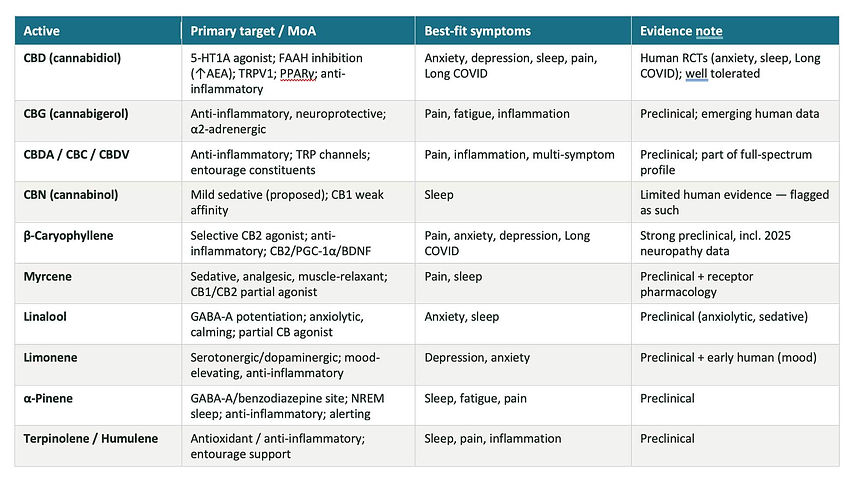
CORE REFERENCES
1. Lu HC, Mackie K. An introduction to the endogenous cannabinoid system. Biol Psychiatry. 2016;79(7):516–525.
2. Russo EB. Taming THC: potential cannabis synergy and phytocannabinoid-terpenoid entourage effects. Br J Pharmacol. 2011;163(7):1344–1364.
3. Russo EB. Clinical endocannabinoid deficiency reconsidered. Cannabis Cannabinoid Res. 2016;1(1):154–165.
4. LaVigne JE, Hecksel R, Keresztes A, Streicher JM. Cannabis sativa terpenes are cannabimimetic and selectively enhance cannabinoid activity. Sci Rep. 2021;11:8232.
5. Raz N, Eyal AM, Fahoum-Khalefa N, Tauber M, Ben-Chaim Y. Selective activation of cannabinoid receptors by cannabis terpenes. Biochem Pharmacol. 2025 (Epub Oct 30).
6. Young TP, Erickson JS, Hattan SL, Guzy S, Hershkowitz F, Steward MD. A single-blind, randomized, placebo-controlled study … Formula C … post-acute COVID-19 syndrome. Cannabis Cannabinoid Res. 2024;9(1):282–292.
7. Hudson R. The big book of terps: understanding terpenes, flavonoids, and synergy in cannabis. Hudson Press; 2021.
8. Hiegel C. A microscopic view of medical cannabis: a handbook for clinicians, medical professionals, dispensary staff, and patients. Hiegel Publishing; 2022.
REGULATORY & SCOPE NOTICE
This reference is educational material for licensed clinicians, health coaches, and functional-health practitioners; it is not medical advice and does not establish a standard of care. It is published by Front Range Pharmaceuticals (FRP), which researches, develops, produces and publishes studies of endocannabinoid-system-targeted therapeutics, including FDA submissions. FRP produces and delivers endocannabinoid system (ECS) education and training to medical professionals. FRP therapeutics are marketed to clinicians by Endourage over the counter (OTC) for clinical use until they are FDA approved. Referenced hemp actives are federally legal nationwide at <0.3% THC and are intended for adult use. Much of the cited terpene and cannabinoid literature is preclinical, as tagged; clinicians should weigh evidence strength and screen for drug-drug interactions using product labels before recommending.
Author disclosure — Michael Steward served as lead author in collaboration with Leonard Wisneski, Byron Jones, and Jamie Wood. Chris Lundwall managed the project and drafted the manuscript. Drs. Wisneski, Jones, and Wood serve on the Front Range Pharmaceuticals Scientific Advisory Board as independent scientific and clinical advisors. Dr. Steward and Mr. Lundwall are company officers.
CONCIERGE FOR CLINICIANS
If you are a clinician seeking more information about ECS therapeutics or Front Range Pharmaceuticals, please visit www.frontrangepharmaceuticals.com or contact chris@frontrangepharma.com.
CHRIS LUNDWALL
Chief Relationship Officer | Front Range Pharmaceuticals
EMAIL: chris@frontrangepharma.com
LINKEDIN: linkedin.com/in/chrislundwall-frp
FRONT RANGE PHARMACEUTICALS • BOTANICAL PHARMACEUTICALS
Authors: Michael D. Steward, MD; Leonard Wisneski, MD, FACP; Byron Jones, MD; Jamie Wood, PhD; and Chris Lundwall, MBA frontrangepharmaceuticals.com
© Front Range Pharmaceuticals 2026 · For Clinician Education · Edition 4.9
APPENDIX
Glossary
Medical terms, medications and products, and acronyms used in this Reference — each with a brief definition and, where useful, its operational context. Evidence tags and citations follow the conventions used throughout the reference.
ACO REACH (Accountable Care Organization Realizing Equity, Access, and Community Health) — A CMS Innovation Center value-based care model. Under its Substance Access BEI, participating clinicians may recommend eligible hemp products to aligned Medicare beneficiaries for symptom control. (CMS, 2026)
ACOG — American College of Obstetricians and Gynecologists. Its 2025 clinical consensus recommends against cannabis use in pregnancy and lactation — the governing obstetric guidance for those populations. (ACOG Clinical Consensus No. 10, 2025)
2-AG (2-arachidonoylglycerol) — The most abundant endocannabinoid; a full agonist at CB1 and CB2, synthesized on demand from membrane lipids and cleared by MAGL. Operationally, it is the ECS’s principal high-output retrograde signal. (Lu & Mackie, 2016)
Agonist / Partial Agonist / Full Agonist — A molecule that activates a receptor. A full agonist produces the maximal response; a partial agonist produces a sub-maximal response even when fully bound. Common terpenes act as low-efficacy partial CB1/CB2 agonists. (Raz et al., 2025)
Allodynia — Pain provoked by a normally non-painful stimulus (e.g., light touch); a hallmark of neuropathic and sensitized pain states that the ECS analgesic pathway is intended to quiet. (Cohen et al., 2021)
Anandamide (AEA) — An endocannabinoid (N-arachidonoylethanolamine); a partial CB1/CB2 agonist that also activates TRPV1 and is degraded by FAAH. CBD raises AEA by inhibiting FAAH — prolonging the body’s own calming signal. (Lu & Mackie, 2016)
Antagonist — A molecule that binds a receptor without activating it, blocking or dampening signaling. CBD behaves as an antagonist at GPR55, for example. (Pertwee, 2008)
Anxiolytic — Anxiety-reducing. Used of CBD (via 5-HT1A/FAAH) and calming terpenes such as linalool (via GABA-A). (Blessing et al., 2015)
Apoptosis — Regulated, programmed cell death in which the cell dismantles itself and is cleared quietly by neighboring cells; typically immunologically silent (tolerogenic). A major — but not exclusive — route of chemotherapy-induced tumor-cell death. (Green et al., 2009)
Area postrema — A brainstem chemoreceptor trigger zone (with the nucleus tractus solitarius) that initiates nausea and vomiting; CB1 signaling here dampens the emetic reflex — the basis of cannabinoid anti-emetic action. (this reference, Cancer Treatment Symptoms)
Astrocytes — Star-shaped glial cells that, when activated, release pro-inflammatory mediators contributing to neuroinflammation and central sensitization — a target of CB2-mediated immune modulation. (Woodhams et al., 2017)
β-Caryophyllene — A sesquiterpene and selective CB2 agonist with anti-inflammatory and analgesic activity; a dietary cannabinoid present in full-spectrum hemp and central to its peripheral, non-intoxicating action. (Gertsch et al., 2008)
BDNF (brain-derived neurotrophic factor) — A protein supporting neuroplasticity and synaptogenesis; reduced BDNF signaling is implicated in depression, and CBD/β-caryophyllene can increase it in preclinical models. (Sales et al., 2019)
Bioavailability — The fraction of an administered dose reaching systemic circulation. Oral phytocannabinoids have low, inconsistent bioavailability (≈13–19%) owing to first-pass metabolism; sublingual dosing partly bypasses it. (Millar et al., 2018)
Biphasic dose-response — An effect that reverses direction with dose — e.g., CBD can be mildly alerting at low doses and calming at higher ones. Operationally, if an effect reverses, adjust the dose rather than simply escalating. (MacCallum & Russo, 2018)
Botanical Drug Development pathway — The FDA route (established 2016) by which a multi-constituent botanical can earn approval under the same standards as single-molecule drugs — the pathway pursued by Front Range Pharmaceuticals. (FDA, 2016)
cAMP (cyclic adenosine monophosphate) — An intracellular second messenger; CB1/CB2 activation inhibits its production (↓ cAMP), part of the mechanism that reduces neurotransmitter release — the ECS ‘brake.’ (Zou & Kumar, 2018)
Cannabimimetic — Producing cannabis-like effects by engaging the ECS. Several common terpenes are cannabimimetic and can selectively enhance cannabinoid activity. (LaVigne et al., 2021)
CB1 / CB2 (cannabinoid receptors 1 and 2) — The two principal ECS receptors, both Gi/o-coupled. CB1 is dense in the CNS and pain axis (the presynaptic ‘brake’); CB2 sits chiefly on immune and glial cells (anti-inflammatory). Full-spectrum hemp engages both at low amplitude. (Zou & Kumar, 2018)
CBC (cannabichromene) — A minor phytocannabinoid with anti-inflammatory and entourage activity; one of the principal actives in the full-spectrum formulation studied in Long COVID. (Young et al., 2024)
CBD (cannabidiol) — The best-studied non-intoxicating phytocannabinoid; a 5-HT1A agonist and FAAH inhibitor that also modulates TRPV1 and PPARγ. It is one component of a full-spectrum formulation — not the product itself. (Blessing et al., 2015)
CBDA (cannabidiolic acid) — The acidic precursor of CBD; contributes anti-inflammatory and TRP-channel activity as part of the full-spectrum profile. (Young et al., 2024)
CBDV (cannabidivarin) — A propyl analogue of CBD present in full-spectrum preparations; investigated for anticonvulsant and anti-inflammatory activity. (Young et al., 2024)
CBG (cannabigerol) — The ‘mother cannabinoid’ precursor; anti-inflammatory and neuroprotective with α2-adrenergic activity, complementing CBD in pain and fatigue formulations. (Booz, 2011)
CBN (cannabinol) — A mildly sedative cannabinoid (proposed) with weak CB1 affinity, sometimes used for sleep; human evidence remains limited and is flagged as such. (this reference, Sleep section)
CDC — U.S. Centers for Disease Control and Prevention. Advises against cannabis (including CBD) while breastfeeding — relevant to counseling lactating patients. (CDC, Breastfeeding: Special Circumstances)
CECD (Clinical Endocannabinoid Deficiency) — Russo’s hypothesis that deficient endocannabinoid signaling underlies treatment- resistant syndromes (migraine, fibromyalgia, IBS). It reframes the goal as restoring tone rather than suppressing symptoms. (Russo, 2016)
Central Sensitization — A state in which spinal/supraspinal neurons become hyperexcitable and descending inhibition weakens, amplifying and sustaining pain independent of ongoing tissue damage. (Cohen et al., 2021)
Certificate of Analysis (COA) — A batch-specific, third-party laboratory report confirming a product’s cannabinoid/terpene content and purity. Required to ‘pass’ the Label Test and to dose from the label with confidence. (Brown & Winterstein, 2019)
CINV (Chemotherapy-Induced Nausea and Vomiting) — Nausea and vomiting triggered by chemotherapy via 5-HT3 and NK1 signaling at the area postrema; two cannabinoids (dronabinol, nabilone) are FDA-approved for refractory cases. (Grimison et al., 2020)
CIPN (Chemotherapy-Induced Peripheral Neuropathy) — Dose-limiting nerve damage from neurotoxic chemotherapy — burning, tingling, numbness — involving TRPV1 sensitization and neuroinflammation; a peripheral CB2 mechanism suppresses it in preclinical models. (this reference, Cancer Treatment Symptoms)
CYP enzymes (cytochrome P450) — Hepatic drug-metabolizing enzymes (e.g., CYP3A4, CYP2C19, CYP2C9, CYP2D6). CBD inhibits several of these, which can raise levels of co-administered drugs — the basis of most hemp drug–drug interactions. (Brown & Winterstein, 2019)
DAGLα (diacylglycerol lipase alpha) — The synthetic enzyme that builds 2-AG on demand; upstream of endocannabinoid tone and a substrate-supply point for the ECS. (Lu & Mackie, 2016)
DAMPs (damage-associated molecular patterns) — Endogenous danger signals (e.g., calreticulin, ATP, HMGB1) released by dying tumor cells during immunogenic cell death; they recruit dendritic cells and help prime an anti-tumor immune response — the mechanism ICD chemotherapy and radiation partly rely on. (Galluzzi et al., 2023)
Descending Inhibition — Top-down pain-dampening pathways (e.g., through the PAG and dorsal horn) that CB1 signaling reinforces; their loss is a driver of chronic pain. (Woodhams et al., 2017)
Dorsal-root ganglia (DRG) — Clusters of sensory neuron cell bodies where CB1 receptors are dense; a key site at which the ECS dampens pain transmission. (Woodhams et al., 2017)
Dronabinol — A synthetic Δ9-THC, FDA-approved for chemotherapy-induced nausea and vomiting refractory to conventional antiemetics and for anorexia — evidence that CB1 agonism has an established anti-emetic, appetite-supporting role. (this reference, Cancer Treatment Symptoms)
DSM-5 — Diagnostic and Statistical Manual of Mental Disorders, 5th edition (APA); the criteria set used to diagnose anxiety and depressive disorders in this reference. (American Psychiatric Association)
Endocannabinoid — An endogenous cannabinoid signal (chiefly AEA and 2-AG) made on demand from membrane lipids, acting locally and then cleared — the messenger the ECS uses to correct drift. (Lu & Mackie, 2016)
Endocannabinoid System (ECS) — The body’s largest neuromodulatory network and master regulator of homeostasis — signals (endocannabinoids), receptors (CB1/CB2 and others), and enzymes (FAAH/MAGL) working as a self-limiting feedback loop. (Lu & Mackie, 2016)
Endocannabinoid Tone — The background level of ECS activity that keeps other systems near their set-points. Its depletion by sustained stressors is the premise of the CECD/depletion model. (Russo, 2016)
Enhancing Oncology Model (EOM) — A CMS Innovation Center oncology payment model; like ACO REACH, an eligible setting for the Substance Access BEI (effective 1 April 2026). (CMS, 2026)
Entourage Effect — The synergistic action of a whole-plant preparation — cannabinoids, terpenes, and flavonoids together — exceeding the effect of any isolated molecule; the rationale for full-spectrum over isolate. (Russo, 2011)
EORTC-CIPN20 — A validated 20-item patient-reported questionnaire measuring chemotherapy-induced peripheral neuropathy; used to track CIPN severity and treatment response. (this reference, Cancer Treatment Symptoms)
Epidiolex (Cannabidiol) — The one FDA-approved prescription CBD (a purified isolate), indicated for specific pediatric epilepsies from age one; the sole rigorous pediatric CBD evidence base, not generalizable to full-spectrum products. (FDA prescribing information, rev. 2024)
FAAH (fatty-acid amide hydrolase) — The degradative enzyme that hydrolyzes anandamide, terminating its signal. Inhibiting FAAH (as CBD partially does) raises AEA — prolonging the body’s own calming signal. (Lu & Mackie, 2016)
Farm Bill (2018) — The Agriculture Improvement Act of 2018, which removed hemp (Cannabis sativa, <0.3% Δ9-THC) from the Controlled Substances Act — making it federally legal and open to ordinary research. (Pub. L. 115-334)
First-Pass Metabolism — Hepatic/gut degradation of an orally swallowed drug before it reaches systemic circulation; the reason oral phytocannabinoids are poorly and inconsistently absorbed and sublingual dosing is preferred. (Millar et al., 2018)
Flavonoids — Plant polyphenols (including cannabis-specific cannflavins) that round out a full-spectrum extract; the least-studied of the three constituent classes contributing to ECS support. (Hudson, 2021)
Formula CTM — The full-spectrum, terpene-rich hemp formulation evaluated in the Long COVID research discussed in Section 6: a single-blind, randomized, placebo-controlled trial and a registered real-world symptom-tracking study (NCT06163690). Its principal measured actives are summarized in the Section 6 ECS Mechanism Map. (Young et al., 2024)
Full-Spectrum — A preparation containing the plant’s complete complement of cannabinoids, terpenes, and flavonoids — never a single-molecule isolate. The indication-targeted formulation, not any one molecule, is the therapeutic. (Russo, 2011)
GABA / GABA-A — Gamma-aminobutyric acid, the main inhibitory neurotransmitter, acting at the GABA-A receptor. Terpenes such as linalool and α-pinene potentiate GABA-A, producing calming and sleep-promoting effects. (Yang et al., 2016)
GPCR (G-protein-coupled receptor) — A large receptor family that signals through intracellular G-proteins; CB1, CB2, 5-HT1A, and GPR55 are all GPCRs, most coupling to Gi/o in the ECS. (Zou & Kumar, 2018)
GPR55 — A putative ‘CB3’ G-protein-coupled receptor contributing immune, bone, and CNS signaling; CBD acts here as an antagonist. (Pertwee, 2008)
Homeostasis — The moment-to-moment maintenance of internal balance across body systems — the outcome the ECS exists to preserve through negative feedback. (Lu & Mackie, 2016)
HPA Axis (hypothalamic–pituitary–adrenal) — The body’s central stress-hormone (cortisol) system. ECS signaling restrains HPA output; overdrive contributes to anxiety, depression, and insomnia. (Blessing et al., 2015)
5-HT1A — A serotonin (5-hydroxytryptamine) receptor subtype; CBD acts as an agonist here, contributing anxiolytic and antidepressant effects. Relevant when hemp is considered alongside serotonergic drugs. (Blessing et al., 2015)
5-HT3 — A serotonin-receptor subtype whose activation by chemotherapy-released serotonin drives acute nausea and vomiting; the target of 5-HT3-antagonist antiemetics (e.g., ondansetron). (this reference, Cancer Treatment Symptoms)
Humulene — A sesquiterpene contributing anti-inflammatory (and appetite-suppressant) activity within full-spectrum pain formulations. (this reference, Pain section)
Hyperalgesia — Heightened pain from a normally painful stimulus; alongside allodynia, a sign of a sensitized nervous system. (Cohen et al., 2021)
Immune Checkpoint Inhibitor (ICI) — A class of immunotherapy (e.g., nivolumab, pembrolizumab, durvalumab) that works by unleashing an anti-tumor immune response. Because its mechanism is immune-inflammatory, concurrent immunomodulatory agents warrant caution and shared decision-making. (Coschi et al., 2025)
Immune-Related Adverse Event (irAE) — An inflammatory or autoimmune side effect of checkpoint-inhibitor therapy. In pooled data, baseline cannabinoid use did not increase irAE incidence. (Coschi et al., 2025)
Immunogenic Cell Death (ICD) — A form of tumor-cell death (induced by anthracyclines, oxaliplatin, cyclophosphamide, and radiation) that releases DAMPs and provokes an anti-tumor immune response; part of the benefit of these regimens depends on it — the basis for caution about blunting inflammation during such treatment. (Galluzzi et al., 2023)
Ionotropic — Describing a receptor that is itself an ion channel (e.g., TRPV1), signaling by direct ion flux rather than through G- proteins; contrast with metabotropic GPCRs. (Muller et al., 2019)
Isolate — A single-molecule product (e.g., pure CBD), organic or synthetic, stripped of the plant’s other actives; by definition it fails the full-spectrum standard and forgoes the entourage effect. (Russo, 2011)
Label Test — Clinician Standard for ECS Therapeutics: developed by Front Range Pharmaceuticals (FRP) as a tool for clinicians practicing evidence-based medicine with ECS therapeutics, and offered to clinicians as a vendor-neutral standard for safe and informed dosing. A medical hemp product passes when its label itemizes every active — cannabinoids and terpenes — with amounts, enabling evidence-based dosing and drug–drug screening from the label alone. (this reference, Label Test section)
Limonene — A citrus monoterpene with serotonergic/dopaminergic, mood-elevating and anti-inflammatory activity; a partial CB agonist used in depression and anxiety formulations. (Ferber et al., 2020)
Linalool — A floral monoterpene (also in lavender) that potentiates GABA-A transmission, producing calming, anxiolytic, and muscle-relaxant effects. (Harada et al., 2018)
Long COVID (PASC) — Post-Acute Sequelae of SARS-CoV-2: multi-system symptoms persisting beyond ≈12 weeks after infection. An indication with human evidence for full-spectrum ECS therapy (see Section 6). (Al-Aly et al., 2024)
Low-Amplitude / Polypharmacology — The pharmacologic signature of full-spectrum hemp: gentle engagement of many ECS targets at once rather than strong action at one — broad, balanced modulation without intoxication. (Russo, 2011)
MAGL (monoacylglycerol lipase) — The degradative enzyme that hydrolyzes 2-AG, terminating its signal; an investigational target for supporting endocannabinoid tone. (Lu & Mackie, 2016)
ME/CFS — Myalgic Encephalomyelitis / Chronic Fatigue Syndrome: ≥6 months of disabling fatigue with post-exertional malaise and no disease-modifying drug — a therapeutic vacuum motivating mechanism-guided options. (IOM/NAM, 2015)
Mechanism of Action (MoA) — The molecular way a drug or active produces its effect. This reference reasons from MoAs — pairing the mechanisms that drive a symptom with the ECS mechanisms that counter them. (this reference, How to Use)
Microglia — The CNS’s resident immune cells; when chronically activated they sustain neuroinflammation. CB2 activation on microglia dampens this pro-inflammatory output. (Woodhams et al., 2017)
Mitotic Catastrophe — Cell death or irreversible arrest triggered by aberrant mitosis after DNA-damaging or spindle-targeting chemotherapy; it frequently resolves into necrosis or apoptosis, illustrating that chemotherapy kills through several death modalities rather than apoptosis alone. (this reference, Cancer Treatment Symptoms)
Monoamine — The neurotransmitter class comprising serotonin (5-HT), norepinephrine (NE), and dopamine (DA); deficits contribute to depression, and CBD/limonene modulate monoaminergic tone. (Malhi & Mann, 2018)
Myrcene — A common monoterpene with sedative, analgesic, and muscle-relaxant activity and CB1/CB2 partial-agonist action; used in pain and sleep formulations. (Raz et al., 2025)
Nabilone — A synthetic cannabinoid FDA-approved for chemotherapy-induced nausea and vomiting refractory to conventional antiemetics — further precedent for cannabinoid pharmacology in oncology supportive care. (this reference, Cancer Treatment Symptoms)
NAPE-PLD — N-acyl-phosphatidylethanolamine phospholipase D, the synthetic enzyme that builds anandamide on demand; a substrate-supply point for endocannabinoid tone. (Lu & Mackie, 2016)
Necrosis — A more disorderly cell death that spills intracellular contents (DAMPs) and is pro-inflammatory; common in solid tumors and after cytotoxic therapy or radiation, and a key reason the inflammation around tumor-cell death is often a consequence of the kill rather than its cause. (Green et al., 2009)
Neuroinflammation — Inflammation within nervous tissue, driven by activated microglia/astrocytes and cytokines; a shared substrate across chronic pain, mood disorders, ME/CFS, and Long COVID that CB2/PPAR pathways counter. (Woodhams et al., 2017)
Neuropathic Pain — Pain from nerve injury or dysfunction — burning, shooting, electric, with allodynia/hyperalgesia; a target of CB2-mediated relief (e.g., β-caryophyllene). (Cohen et al., 2021)
Neuroplasticity — The nervous system’s capacity to remodel synapses and circuits; reduced (BDNF-dependent) plasticity is implicated in depression, and ECS support may promote synaptogenesis. (Sales et al., 2019)
NF-κB — A master transcription factor driving inflammatory gene expression; PPARα/γ engagement (by CBD/CBG) suppresses NF-κB, an anti-inflammatory mechanism. (Muller et al., 2019)
NK1 (neurokinin-1 receptor) — The substance-P receptor mediating delayed chemotherapy-induced vomiting; the target of NK1- antagonist antiemetics (e.g., aprepitant). (this reference, Cancer Treatment Symptoms)
Nociceptive / Nociplastic Pain — Nociceptive pain arises from actual/threatened tissue damage; nociplastic (systemic) pain arises from altered central processing without clear tissue or nerve damage (e.g., fibromyalgia). (Cohen et al., 2021)
Nociceptor — A sensory neuron that detects noxious stimuli; peripheral injury/inflammation lowers its threshold (partly via TRPV1), initiating pain signaling. (Cohen et al., 2021)
Nuclear Receptor — A receptor that regulates gene transcription from within the cell (e.g., PPARα/γ), as opposed to membrane receptors; the route by which cannabinoids exert metabolic and anti-inflammatory effects. (Muller et al., 2019)
Over-the-Counter (OTC) — Sold lawfully without a prescription (Merriam-Webster). Front Range Pharmaceuticals (FRP) develops and publishes studies of these therapeutics, which Endourage markets to clinicians for clinical use until they are FDA approved. (this reference, Methodology)
Overall Survival (OS) — Time from treatment start to death from any cause; the definitive oncology outcome. Across current studies, cannabinoid use has not shown a consistent effect on OS with checkpoint-inhibitor therapy. (Coschi et al., 2025)
PAG (periaqueductal gray) — A midbrain hub of descending pain control rich in CB1 receptors; a site where endocannabinoids reinforce pain inhibition. (Woodhams et al., 2017)
PGC-1α — A transcriptional coactivator of mitochondrial biogenesis; β-caryophyllene engages a CB2/PGC-1α/BDNF pathway relevant to mood and cognition. (Bahi et al., 2014)
Phytocannabinoid — A plant-derived cannabinoid (e.g., CBD, CBG, THC), as distinct from an endocannabinoid; the ligands full- spectrum hemp supplies to engage the ECS. (Pertwee, 2008)
Post-Exertional Malaise (PEM) — Worsening of symptoms after minimal physical or cognitive exertion; a defining, disabling feature of ME/CFS and Long COVID managed in part by pacing. (IOM/NAM, 2015)
PPARα / γ — Peroxisome proliferator-activated receptors (nuclear): their engagement suppresses NF-κB-driven inflammation and supports metabolic/mitochondrial function; targets of CBD and CBG. (Muller et al., 2019)
Progression-Free Survival (PFS) — Time from treatment start until disease progression or death; a common oncology efficacy endpoint. A pooled analysis reported improved immune-PFS with baseline cannabinoid use, though without an OS difference. (Coschi et al., 2025)
PROMIS — Patient-Reported Outcomes Measurement Information System (NIH); validated domains (pain, sleep, anxiety, depression, fatigue) used to measure response and titrate on data, not impression. (NIH PROMIS)
Retrograde Messenger — A signal released from the postsynaptic cell that travels backward across the synapse to quiet the presynaptic terminal — the mode by which endocannabinoids make small, targeted corrections. (Lu & Mackie, 2016)
Schedule I — The most restrictive U.S. drug classification (‘no accepted medical use, high abuse potential’). Cannabis’s Schedule I status long suppressed rigorous research — context for reading pre-2018 evidence critically. (Nutt et al., 2013)
Selective Agonist — A molecule that activates one receptor subtype preferentially — e.g., β-caryophyllene at CB2 — achieving a targeted effect (here, anti-inflammatory) without CB1 psychoactivity. (Gertsch et al., 2008)
Spike Protein — The SARS-CoV-2 surface protein implicated in persistent post-viral inflammation; a proposed driver of Long COVID that CB2/PPARγ anti-inflammatory action may counter. (Al-Aly et al., 2024)
SSRI / SNRI / TCA — Antidepressant classes (selective serotonin, and serotonin-norepinephrine, reuptake inhibitors; tricyclics). Relevant to interaction screening, as CBD can raise levels of some via CYP inhibition. (Antoniou et al., 2020)
Start Low, Go Slow — The governing dosing principle: begin at a low dose and titrate gradually to effect — which also limits any interaction magnitude. ‘...and don’t be afraid to go all the way’ to therapeutic benefit. (MacCallum & Russo, 2018)
Sublingual / Oromucosal — Administration under the tongue for mucosal absorption; delivers a measured, titratable dose that partly bypasses first-pass metabolism — the preferred systemic route for medical hemp. (Millar et al., 2018)
Substance Access BEI (Beneficiary Engagement Incentive) — An optional CMS Innovation Center benefit (ACO REACH and the Enhancing Oncology Model, effective 1 April 2026) that lets participating clinicians discuss and furnish eligible hemp products (≤0.3% Δ9-THC, non-inhalable), up to $500/year, to aligned Medicare beneficiaries for symptom control after shared decision- making and medication review. (CMS, 2026)
Terpene — An aromatic plant compound; in cannabis, terpenes are active pharmacology — partial CB1/CB2 agonists engaging additional targets (GABA-A, TRPV1) — and must appear on a Label-Test-compliant label. (Raz et al., 2025)
Terpinolene — A monoterpene with antioxidant and anti-inflammatory activity contributing entourage support in sleep and pain formulations. (this reference, Master Actives)
THC / Δ9-THC (Δ9-tetrahydrocannabinol) — The intoxicating cannabinoid; in compliant hemp it is present below 0.3%. Non- intoxicating, low-amplitude engagement is the clinical aim, but even trace THC can trigger a positive vocational drug test. (Pertwee, 2008)
Titration — Systematic, stepwise dose adjustment to the lowest dose that produces benefit without unwanted effects; made exact by Label-Test-compliant products that state each active in milligrams. (MacCallum & Russo, 2018)
Topical / Transdermal — Topical delivery treats localized symptoms with minimal systemic exposure (and little interaction risk); transdermal patches deliver systemically. Topical is a preferred route where systemic exposure must be avoided. (Millar et al., 2018)
TRPV1 — Transient Receptor Potential Vanilloid 1, an ionotropic channel activated by anandamide and CBD; sustained activation desensitizes it, reducing nociceptor firing — an analgesic mechanism. (Muller et al., 2019)
Warfarin — An anticoagulant metabolized by CYP2C9; CBD can inhibit CYP2C9 and raise warfarin exposure (elevated INR, bleeding reported). Monitor INR closely or consider a topical route. (Grayson et al., 2017)
WHO — World Health Organization. Its Expert Committee found CBD generally well tolerated, non-intoxicating, and without abuse potential — a key safety reference. (WHO, 2018)